Uncrewed submarines: the new hybrid threat in 21st-century naval warfare
By Kike Gandia · Defense & Geopolitics · 4 min read
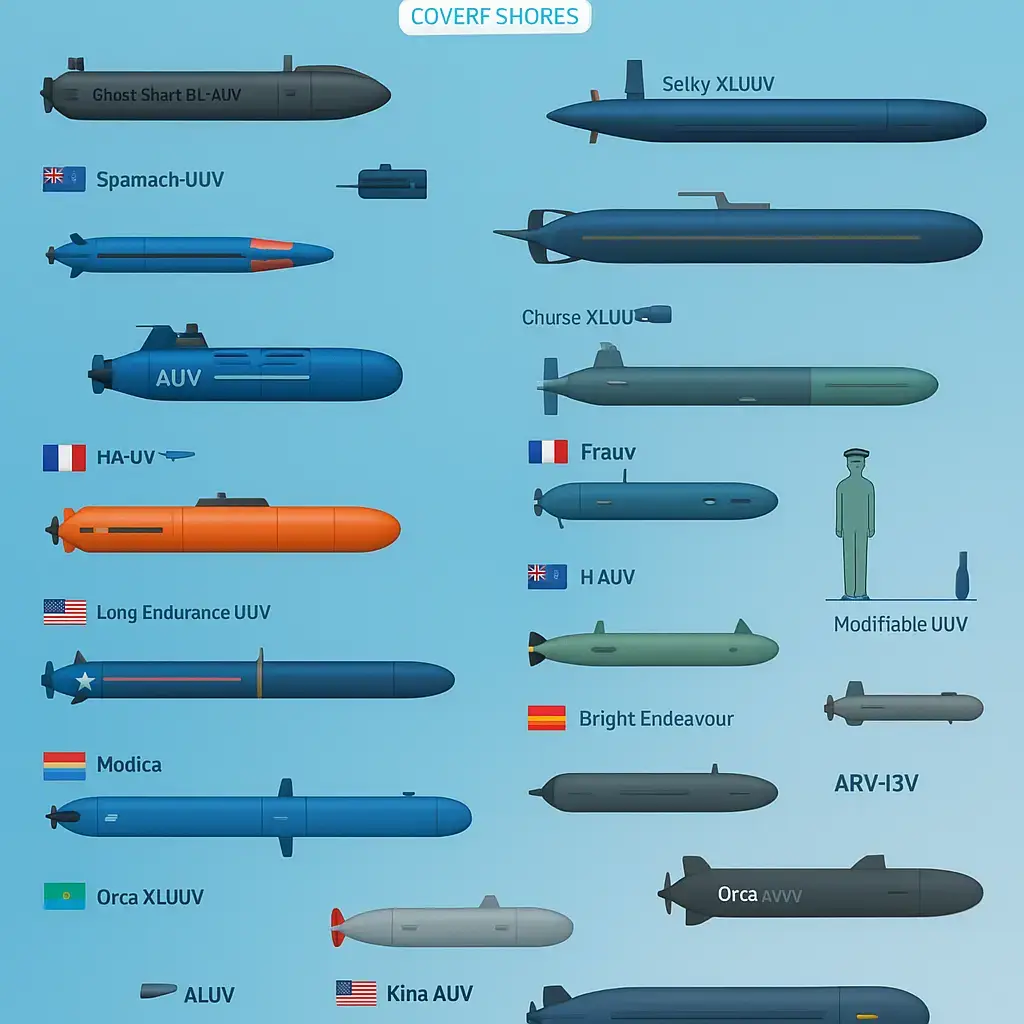
In an era when digital stealth is no longer enough, the ocean has become the new theater of invisible operations. On April 28, 2025, China unleashed its own technological kraken on the world: the Blue Whale, an 11-meter autonomous underwater vehicle (AUV) able to roam the oceans for 30 days without a single soul on board. While Beijing's official statements talk about “scientific exploration” and “climate monitoring”, the darker corridors of Western naval intelligence are whispering something else: that the Blue Whale was not born in a defense lab, but in the damp belly of Latin American drug trafficking.
Yes, you read that right. What China now presents as the crown jewel of its ocean AI program may in fact be the militarized evolution of an invention that came out of the Colombian jungle and the clandestine shipyards of Sinaloa. Because before the Blue Whale, there was the Bigfoot Sub.
From the swamp to the battlefield: how the narcos inspired the dragon
In the late 1990s, the Colombian cartels had a problem: how to move tons of cocaine without being spotted by the DEA or US satellites. The answer? Submarines. Or, more precisely, homemade semi-submersibles, coated in epoxy, powered by outboard motors, with an almost zero thermal signature and enough range to reach Florida or Galicia without arousing suspicion.
In 2022, Spain intercepted an autonomous narco-sub for the first time, in Cádiz. There was nobody on board, just 200 kg of cocaine and a GPS-programmed route. It was a prototype, but the message was clear: autonomy was no longer science fiction.
Meanwhile, on the other side of the world, China's naval engineers seemed to be taking notes. Because the Blue Whale not only has a hydrodynamic silhouette almost identical to the Galician narco-subs, it also shares the same design principles: low thermal profile, extreme endurance and resistance to satellite tracking.
Coincidence... or strategic inspiration.
- Late 1990s — The Colombian cartels solve the stealth problem
Homemade semi-submersibles, coated in epoxy, powered by outboard motors and with an almost zero thermal signature, able to reach Florida or Galicia without arousing suspicion. - 2022 — Spain intercepts the first autonomous narco-sub
In Cádiz, with nobody on board: 200 kg of cocaine and a GPS-programmed route. A prototype, but autonomy stops being science fiction. - April 28, 2025 — China unveils the Blue Whale
A hydrodynamic silhouette almost identical to the Galician narco-subs and the same design principles: low thermal profile, extreme endurance and resistance to satellite tracking.
The sequence the article reconstructs: from the clandestine shipyard to a state's naval program.
Blue Whale: specs that smell military
- 11 m
- in length (12 tons in weight)
- 30 days
- of endurance without human intervention
- 36 knots
- on the surface (10+ knots submerged)
- 2 t
- of payload (sensors, weapons, drugs)
- Maximum depth: 60 meters
- Navigation system: autonomous AI, immune to GPS interference
- Toughness: withstands category 12 typhoons
- Extreme modularity: from oceanographic mapping to surveillance, sabotage or cross-border smuggling
China insists it will be used for peaceful, scientific purposes: “typhoon monitoring” and “biodiversity protection”. But since when do you need spoofing-hardened AI to study coral reefs?
The dual-use disguise. Unlike a nuclear submarine or a radar-visible destroyer, the Blue Whale can operate invisibly, anonymously and autonomously. It needs no port, no crew, and takes no orders over the radio. By the time you find it, it is already too late.
Haiti, Cuba and the fishing fleet that doesn't fish
According to multiple naval intelligence reports gathered by QuantumSec, China has allegedly set up an experimental AUV base on the outskirts of Gonaïves, Haiti, under the umbrella of fisheries cooperation and humanitarian aid.
But that Cuban “fishing fleet”, which regularly crosses over to Haiti, seems to have little interest in tuna. It is suspected of running covert tests with Blue Whale prototypes, using the murky waters of the Caribbean as a lab beyond Western oversight.
Why there? Because neither the US nor NATO has full control of that region, and because Haiti and Cuba have long served as hubs for regional smuggling, with logistics infrastructure ready for clandestine operations. Some sources even suggest these vehicles may already be collecting:
- Acoustic signals from US undersea cables
- Intelligence on commercial shipping traffic
- Data on NATO military exercises
From Blue Whale to “NarcoWhale”: who can control this technology?
Now for the uncomfortable question: if China can build these AUVs... who else can?
Today, a homemade narco-sub is estimated to cost around $2 million. But a second-hand autonomous underwater drone, with onboard AI and ocean-going endurance, could cost less than a Lamborghini Huracán.
Homemade narco-sub the previous generation
- Estimated cost of $2 million.
- Crew on board, with everything that implies if it gets intercepted.
- Built by hand in a clandestine shipyard.
Second-hand autonomous underwater drone what's coming
- Could cost less than a Lamborghini Huracán.
- Onboard AI and ocean-going endurance, with nobody on board.
- Can be replicated through reverse engineering.
The cost comparison the article sets out: what makes the technology cheaper is not the vehicle, it's doing away with the crew.
Picture this scenario:
- A cartel buys a modified Blue Whale on the black market (or builds one through reverse engineering)
- It programs it to cross the Atlantic with half a ton of fentanyl
- On arrival, it leaves it beached in a Galician cove… and vanishes
No calls, no radar, no trace.
But it's not just the cartels. These drones could also end up in the hands of:
- Terrorism Terrorist groups
- They use them to lay mines in strategic ports.
- State Covert state actors
- They sabotage infrastructure without leaving a visible signature.
- Commercial Surveillance companies
- They rent them out as underwater satellites to spy on cables, pipelines and gas routes.
The sea as an “aquatic cyberspace”: a domain where hybrid warfare is not just possible, but likely.
The sea thus becomes the new “aquatic cyberspace”, a domain where hybrid warfare is not just possible, but likely.
China, dual-use technology and the perfect disguise
In the technology war, “dual use” is the wild card of the 21st century. A weather satellite or a spy camera? A civilian rocket or a missile? A research submarine or an autonomous bomb?
The Blue Whale, with its modularity and onboard AI, is the textbook definition of a dual-use system.
And the most dangerous part is that, unlike a nuclear submarine or a radar-visible destroyer, the Blue Whale can operate invisibly, anonymously and autonomously. It needs no port, it needs no crew, and it takes no orders over the radio.
By the time you find it, it is already too late.
Conclusion: the future will be underwater, autonomous and criminally creative
What we are witnessing is not just the emergence of a new class of naval weapon. It is the militarization of a technology inspired by criminals, perfected by a state, and about to be released onto the global market for hybrid conflict.
The Blue Whale is the perfect symbol of our times: sophisticated, ambiguous, lethal… and born in the shadows.
Welcome to the invisible war of the 21st century.
Radar won't see it coming.
Neither will you.
Related service
Threat intelligence and threat analysis
Topics
#AUV #Warfare-algorithms #Blue-Whale #Maritime-OT-ICS-security #Underwater-drones #Naval-hybrid-warfare
Keep reading
- The digital grenade in cyberwarfare: Neutralizing and jamming communications
- Multi-domain and mosaic warfare: the new US military thinking, by Guillermo Pulido Pulido
- Honeypots and canary tokens: defending corporate networks against sophisticated adversaries
- Wars are not won with nuclear bombs, but with plastic
- The American Silk Road: how China is conquering the Americas from Mexico