Multi-domain and mosaic warfare: the new US military thinking, by Guillermo Pulido Pulido
By Kike Gandia · Defense & Geopolitics · 30 min read
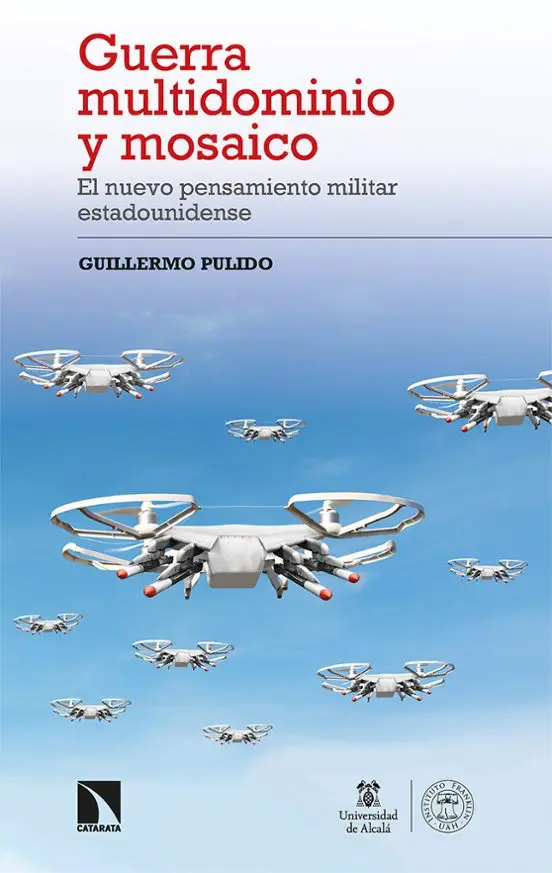
Guerra multidominio y mosaico. El nuevo pensamiento militar estadounidense (“Multi-domain and mosaic warfare: the new US military thinking”, Ed. Catarata, 2021) offers a comprehensive overview of the doctrinal and technological revolution that has been taking shape in the United States since 2014. The author describes how a new way of waging war is emerging, built on units organized as robot swarms, multi-domain operations and mosaic force designs, in response to the erosion of the Western military edge by the progress of powers such as China, Russia and Iran. In November 2014 the Pentagon launched the Third Offset Strategy, marking the start of deep theoretical and doctrinal changes aimed at preserving US military-technological superiority. What follows is a detailed analysis of the book, including a chapter-by-chapter summary, an explanation of its key concepts, a critical look at the author's approach, the reception and impact of the work in the Spanish-speaking strategic community, and a comparison with US, Chinese and Russian doctrine.
Guillermo Pulido Pulido is a political scientist and researcher specializing in strategic thought and contemporary military transformation. He holds a PhD in Political Science and has focused his academic work on emerging defense doctrines, with particular attention to the United States and the Asia-Pacific. Alongside his work as a science communicator, he has collaborated with strategic studies centers and specialist publications, becoming one of the most authoritative Spanish-language voices on the new forms of warfare built on autonomy, multi-domain operations and technological revolution.
From the gray zone to the swarm: a full tour of the book
- Origins — From Ogarkov to the doctrinal revolution
Pulido traces the historical and intellectual origins of the shift, going back to the thinking of Soviet Marshal Nikolai Ogarkov. - Gray zone — Neither peace nor war
Far from reducing it to a midpoint, the book defines it as a space in its own right, where competition is permanent and never crosses the threshold of open conflict. - Multi-domain — Every branch reorganizes
How the US Army and the Marine Corps — with the EABO doctrine and its small, dispersed units — adopt multi-domain warfare. - Mosaic — DARPA's formula
Many small, recomposable systems instead of a few exquisite platforms: iterate faster, cut costs and complicate the adversary's calculations. - Swarm — The likely shape of future combat
Swarm warfare and the methods to counter it: directed energy, electronic warfare and friendly swarms.
The book's arc, from Soviet thinking in the seventies to the swarm.
Guerra Multidominio y Mosaico, written by Guillermo Pulido Pulido and published in 2021 by Los Libros de la Catarata, is one of the most ambitious Spanish-language studies of the doctrinal transformation of US military thinking in the 21st century. Pulido, a political scientist and strategic studies expert, examines how the United States has redefined the way it conceives of and wages war in response to the decline of its traditional technological edge over powers such as China and Russia. At the heart of this conceptual shift is the so-called Third Offset Strategy, launched in 2014 by then Secretary of Defense Chuck Hagel. Inspired by figures such as Robert Work and think tanks such as CSBA, the strategy sought to establish a new military superiority through intensive use of emerging technologies such as artificial intelligence, robotics, autonomy, distributed networks, electronic warfare, cyber defense and hypersonic weapons.
Pulido traces the historical and intellectual origins of this doctrinal revolution, going back as far as Soviet Marshal Nikolai Ogarkov, who in the 1980s was already anticipating a “revolution in military affairs” built on precision systems, drones and digitized command. This context allows the author to frame the evolution of US military thinking as a long-term process: from the nuclear deterrence strategy of the 1950s, through the technological superiority of the 1990s, to a present in which war extends across every domain, including information, cyberspace and outer space.
One of the key concepts the book addresses is the “gray zone”. Far from reducing it to a simple middle ground between peace and war, Pulido defines it as a form of strategic competition that uses political, economic, cyber and information tools, often below the threshold that would trigger a conventional military response. Actors operating in the gray zone seek to force a change in the status quo through controlled escalation, using ambiguous tactics that avoid open war but still prove effective. Examples such as Russia's annexation of Crimea in 2014 or Chinese activity in the South China Sea illustrate this kind of conflict. The author also introduces the concept of “salvo competition”: limited clashes settled by exchanges of missiles or drones, with no need for massive troop deployments, reflecting a form of war that is increasingly remote, automated and precise.
Building on this strategic reading, Pulido examines how each branch of the US Armed Forces has adopted multi-domain warfare doctrine. The US Army has developed new structures such as the Multi-Domain Task Forces, made up of units specializing in intelligence, electronic warfare, and cyber and space operations, able to operate across all domains simultaneously. These forces are designed to take on near-peer threats such as China or Russia and have been deployed on an experimental basis in the Indo-Pacific and in Europe. The Army is also pushing the “Big Six” program, which covers six priority modernization areas: long-range artillery, next-generation combat vehicles, advanced aircraft, resilient command and control networks, integrated air defense and improved individual soldier lethality. All of this is coordinated by Army Futures Command, created in 2018.
The Marine Corps (USMC), for its part, has adopted the EABO (Expeditionary Advanced Base Operations) doctrine, which means reorganizing into small, mobile units capable of setting up advanced bases on strategic islands or coastlines and denying the adversary the use of certain maritime areas by deploying anti-ship missiles and defensive systems. These bases, hard to locate and strike, are integrated with the distributed maritime operations of the US Navy, which has adopted concepts such as “Distributed Lethality” to spread its offensive power across many smaller platforms, including uncrewed vessels, and so complicate enemy planning. The Air Force (USAF), meanwhile, has deepened air-cyber-space integration with initiatives such as JADC2 (Joint All-Domain Command and Control), which aims to link every sensor, platform and weapon system in a common network that speeds up the military decision cycle. It has also developed concepts such as crewed fighters accompanied by autonomous “loyal wingman” drones and swarms of uncrewed aerial systems to defeat advanced defenses.
Against this backdrop, one of the book's central threads is its explanation of “mosaic warfare”, a concept formulated by DARPA. It is a way of fighting built on the modularity and interoperability of many small, cheap systems — drones, sensors, smart munitions, communications nodes or uncrewed platforms — that can be combined flexibly to fit each mission. Unlike traditional monolithic systems (aircraft carriers, fifth-generation fighters), the mosaic approach prioritizes flexibility, redundancy and the ability to recompose quickly after failures or losses. The analogy DARPA's designers use is an artistic mosaic: each individual tile has a limited function, but together they form a complex and effective picture. This way of conceiving war makes it possible to generate many simultaneous effects at different points on the battlefield, collapsing the enemy's decision cycles and creating a non-linear tactical environment.
Mosaic warfare also implies a change in the logic of the defense industry: it allows technology solutions to be iterated and fielded faster, costs to be cut and innovation to be democratized. Programs such as Skyborg (modular autonomous combat drones) are concrete examples of this philosophy. Pulido acknowledges, however, that full adoption faces institutional obstacles such as the Pentagon's bureaucratic rigidity, slow acquisition and budgeting processes, and dependence on legacy systems that soak up spending. He argues that the United States must reform its industrial ecosystem and its procedures to stay ahead in the technology race with China. In this race between techno-military regimes, each power is competing to impose a new operational and doctrinal paradigm. Mosaic warfare is the US bet on keeping the initiative, set against the Chinese strategy of saturation with missiles, swarms and anti-access.
In the final part of the book, Pulido turns to swarm warfare, which he considers one of the most likely forms of future combat. He defines the swarm as the coordinated, simultaneous attack of large numbers of autonomous or semi-autonomous units from multiple directions, able to adapt in real time and overwhelm enemy defenses. Drawing on Sean Edwards' studies and the theories of Arquilla and Ronfeldt (RAND), the author argues that this form of combat is an evolution beyond wars of mass or maneuver: these would now be wars of interconnected, distributed, intelligent nodes that behave like a superorganism. The swarm's collective intelligence makes it possible to generate disproportionate effects with simple, cheap means. Its advantages include spreading risk, the resilience of the whole when individual units are lost, and the ability to keep presenting the adversary with operational dilemmas.
Pulido also discusses methods for countering swarms, such as directed-energy weapons (lasers), electronic warfare and even defensive swarms. He also introduces the concept of “robot guerrilla warfare”, in which small autonomous systems act as technological insurgents, carrying out surprise attacks, infiltration or sabotage with unprecedented flexibility and persistence. This new form of combat calls for redesigning not only conventional armed forces but also command models, logistics, data protection, cyber defense and the control of autonomy.
Taken as a whole, Guerra Multidominio y Mosaico is a book that synthesizes, with clarity and depth, a series of doctrinal and technological transformations that will shape the conflicts of the future. Pulido does not just describe concepts; he analyzes them from a strategic and political perspective, bringing together military history, the theory of war, technological innovation and institutional analysis. His approach is rigorous, well documented and educational, which makes the book an indispensable reference for defense specialists as well as academics, analysts and anyone interested in today's security challenges. Its publication has also had a notable impact on the Spanish-language strategic debate, opening the door to new lines of research and training on 21st-century warfare.
Strategic and operational foundations of future conflict
Third Offset Strategy
The Third Offset Strategy is a strategic plan drawn up by the US Department of Defense from 2014 onward to restore its military edge over near-peer competitors such as China and Russia. It is the third major doctrinal move designed to offset strategic asymmetries: the first was based on nuclear deterrence (1950s), the second on technological superiority in sensors and precision guidance (1970s–80s). This third bet focuses on integrating emerging technologies — such as artificial intelligence, robotics, autonomous systems, hypersonics and advanced computing — to deal with hostile environments characterized by anti-access and area-denial constraints. The goal is to project power in complex theaters through forces that are more agile, distributed, resilient and lethal, able to operate across multiple domains without relying on traditional supremacy.
Gray zone
The gray zone concept describes a space between conventional peace and open war. It is neither a prelude to war nor a diluted form of it, but a specific mode of strategic confrontation that uses ambiguity, plausible deniability and incremental pressure to avoid a direct military response. Gray-zone actions combine coercive diplomacy, information operations, cyberattacks, political destabilization, paramilitary activity and economic manipulation, without formally crossing the threshold of war. The aim is to gain ground — physical, symbolic or political — without triggering armed escalation. Textbook examples are Russia's “forces without insignia” in Crimea, Chinese maritime militias, and election interference campaigns run through digital media. This form of strategic competition exploits legal uncertainty and the political cost of war to reshape the status quo without firing a single missile.
Multi-domain warfare (MDO)
Multi-domain warfare proposes unprecedented operational integration across every arena of confrontation: land, sea, air, space, cyberspace and the electromagnetic spectrum. Instead of separate campaigns in each domain, the doctrine calls for synchronized, simultaneous effects on multiple planes, which demands a very high level of technological, doctrinal and structural coordination. In a multi-domain scenario, a cyberattack can prepare the ground for a land assault, while a space maneuver can neutralize air defenses. The concept starts from the premise that the adversary (especially China or Russia) will not respect the classic divisions, but will use hybrid, layered and cross-cutting tools. The ability to “connect the dots” is therefore worth more than the individual power of any one system. Putting this doctrine into practice involves unified command networks, interoperable platforms and new structures such as the US Army's multi-domain units.
Mosaic warfare
The term Mosaic Warfare, developed by DARPA, refers to a new operational paradigm built on tactical modularity. Instead of relying on heavy, expensive, multi-role systems, it proposes fielding a constellation of simple, specialized and cheap components that fit together like a mosaic to carry out operational functions. Each “tile” in the mosaic can be a drone, a sensor, a communications system or a firing platform. The strength lies not in the individual power of each element but in its ability to combine dynamically depending on the context. This architecture makes it easier to keep pace with modern conflict, cut costs, tolerate losses and saturate enemy defenses. Its logic follows the principle of intelligent dispersion: overwhelm the enemy with many simultaneous dilemmas, collapsing its ability to decide. It is also a bet on a flexible industrial ecosystem, based on agile production of interconnectable systems, as opposed to the traditional model centered on single platforms with long development cycles.
Swarm warfare
Swarm warfare relies on the coordinated deployment of large numbers of autonomous units — such as drones, robots or cyber nodes — acting simultaneously to overwhelm the enemy's defensive capabilities. Unlike hierarchical military formations, the swarm operates as a decentralized network in which each unit acts with relative autonomy while staying connected to the rest through shared intelligence. The result is a distributed, flexible and redundant force that strikes from multiple directions, saturates sensors and defenses, and reorganizes after every hit. This logic breaks with the model of concentrated force and embraces superiority through numbers, coordination and speed. The swarm is harder to predict, locate and neutralize, and it points to a deep change in the ontology of combat: from centralized maneuver to emergent synchronization. It is a form of “robotic guerrilla warfare” that can operate even in urban or dispersed settings, combining kinetic attacks with disinformation or cyberattacks. Its effectiveness depends on connectivity and distributed artificial intelligence.
A2/AD (Anti-Access / Area-Denial)
A2/AD is a set of doctrines and technologies whose aim is to deter or prevent an adversary from entering or operating freely in a given region. It relies on integrating long-range missiles, air defenses, electronic warfare, naval mines, anti-satellite systems and cyber capabilities. The idea is that any attempt by the opponent to project power becomes prohibitively costly or ineffective. China and Russia have deployed extensive A2/AD belts in the South China Sea, Kaliningrad and other strategic areas. These environments are so saturated with threats that they restrict the movement and initiative of Western forces. Multi-domain doctrine and mosaic warfare emerged as a direct response to these defensive bubbles, looking for unconventional ways — such as swarms, stealth platforms or cyber penetration — to disrupt A2/AD nodes and restore operational freedom of action.
EABO (Expeditionary Advanced Base Operations)
The EABO concept redefines the role of the US Marine Corps in the Indo-Pacific. The doctrine calls for deploying temporary advanced bases in strategic locations, such as archipelagos or coastlines near disputed areas. These light, self-sufficient, mobile bases are equipped with anti-ship missiles, anti-aircraft systems, sensors and cyber capabilities that make it possible to contest control of the sea from land. The purpose is to build “invisible fortresses” that deny the adversary access without the need for large fixed infrastructure. EABO combines tactical flexibility with deterrent effect: the enemy faces multiple hidden, mobile defensive positions that cannot be eliminated without a high cost. It is, in essence, a method of “dispersed anti-access” that complements the US Navy's distributed naval doctrine. It also requires more agile logistics, more decision-making autonomy for units on the ground and full integration with joint command networks.
Big Six
The US Army defined six critical areas for modernizing its land force to meet the challenges of the 21st century. These priorities, known as the Big Six, are:
- Long-range precision fires
- to defeat A2/AD defenses from safe distances.
- Next-generation combat vehicles
- more lethal, lighter and possibly autonomous.
- Future Vertical Lift
- a new family of faster, stealthier and modular rotorcraft.
- Resilient tactical networks
- able to operate under electronic warfare and in denied environments.
- Air and missile defense
- strengthening the protection of units at the front and in the rear.
- Soldier lethality
- with improvements in weapons, vision, protection, sensors and training.
The capabilities that define an army able to fight in a multi-domain environment.
These programs are coordinated by Army Futures Command, created to speed up innovation and break the slow cycles of the traditional acquisition system. Taken together, the Big Six aim not only to adapt the Army to multi-domain warfare but to restore its relevance as a decisive force in high-intensity conflict.
A critical look at the author's approach
Guillermo Pulido's book stands out for its comprehensive, scholarly view of a set of cutting-edge military concepts that, until it was published, had barely been covered in depth in Spanish. The main originality of his approach is that it brings together many recent US doctrinal debates (gray zone, multi-domain, swarms, mosaic, etc.) in a single coherent volume. Pulido manages to “connect the dots” between ideas that are often discussed in isolation: for example, he links the rise of gray-zone tactics to the need for multi-domain battle, or ties the mosaic concept to winning the technology race, weaving a logical cause-and-effect narrative. This ability to fit scattered theories into an understandable framework is a valuable contribution to the Spanish-language strategic studies literature. The author also grounds his arguments firmly in history and theory: he anchors today's developments in precedents such as the Revolution in Military Affairs of the 1990s and even Soviet thinking of the 1980s, offering a long-term perspective that enriches the analysis. By recalling Ogarkov's predictions or the AirLand Battle doctrine, for instance, Pulido avoids presenting current trends as passing fads and instead frames them as part of a continuous evolution of military thought.
In terms of theoretical rigor, Pulido takes a political-science and strategic approach: he draws on concepts from the theory of strategic competition (balances of power, the innovator's dilemma, etc.) and analyzes “techno-military regimes” with a degree of academic rigor. This analytical lens — possibly shaped by his doctoral training — adds depth beyond simple technical description. The book is extensively referenced, reflecting a remarkable research effort; it draws on sources ranging from US think-tank reports (RAND, CSBA) to official doctrine and academic literature. Its theoretical and documentary foundations are therefore solid, which lends credibility to his claims and puts them in the right context. He does not, for example, merely mention mosaic warfare: he quotes its creators' explanations at DARPA, and when discussing swarms he references Arquilla and Ronfeldt's ideas, showing a determination to back every concept with its intellectual origin.
One of the author's strengths is his gift for explanation: he defines slippery terms such as “gray zone” or “multi-domain battle”, which are often oversimplified, and explores them with nuance. In the words of one reviewer, Pulido “unpacks the terms multi-domain and mosaic” clearly and in detail, giving general readers a deeper understanding of what are, at root, highly specialized debates. The book also includes charts and diagrams in chapters such as the one on swarms, which make complex concepts easier to grasp visually. This points to a genuine effort by the author to convey difficult ideas accessibly without sacrificing rigor.
As for possible limitations or criticisms, it is worth noting that the book focuses almost exclusively on the US perspective, which was its stated purpose (as the subtitle, “the new US military thinking”, indicates). Even so, some readers may miss a stronger critical contrast with sources from other powers: for example, do China or Russia have alternative doctrines that challenge the assumptions behind the offset strategy? Pulido does address the Chinese and Russian response to some extent (especially in chapter 5, when discussing the arms race), but the analysis relies largely on how the US imagines that competition. This does not detract from the content, but it defines its scope: it is a study of US doctrinal discourse rather than a systematic multi-country comparison.
Another criticism raised after publication concerns the excessive novelty attributed to certain concepts. In the chapter on swarm warfare, for example, Pulido emphasizes the revolutionary character of swarm tactics, presenting them almost as a historical watershed. Some analysts have pointed out that this framing may overstate how new swarming is, since coordinated attacks and enemy saturation have existed for centuries (nomadic armies, human-wave tactics, etc.); it is just that they are now carried out with drones. It has been argued that the book seems to place “swarm warfare” on a timeline that puts it after the “maneuver warfare” of the late 20th century, when in reality maneuver and swarming are not sequential phases but concurrent or recurring approaches throughout history. That said, this criticism is perhaps more a matter of emphasis: Pulido wants to highlight the future importance of the robotic swarm and contrasts it with earlier paradigms to do so, although it is true that the line between one and the other is not always clear-cut.
Likewise, the author's technological optimism in presenting concepts such as mosaic warfare arguably comes with challenges that would merit more critical discussion. Although Pulido mentions institutional inertia and the need for change in industry (chapter 5), issues such as the vulnerability of communications in distributed networks, the risks of lethal autonomy or the ethical implications of robotized armed forces could perhaps have been explored further. Similarly, the book largely takes official US doctrinal positions at face value, accepting their premises (for example, that multi-domain integration will in fact deliver the advantage, or that artificial intelligence will be decisive). A more skeptical stance might ask: what if these new doctrines have blind spots? Is there a risk that the US invests massively in these ideas and the adversary counters them with some unexpected approach? Although the book does not dig into possible counterarguments, its main mission was to set out the state of the art in US doctrine, and that it achieves comfortably.
On balance, Pulido's approach is rigorous and thorough, even if at times it errs on the side of enthusiasm. The main criticism may simply be that the ground covered is so broad (strategic policy, the doctrines of four services, emerging technology, military theory) that some topics cannot be analyzed in equal depth. Even so, the book strikes a difficult balance: it is broad in scope yet remains cohesive, guided by the central idea of a new US military revolution. That is why it has been regarded as a pioneering contribution to the Spanish-language literature, despite the natural debate that each specific doctrinal position may spark.
The book's impact on the Spanish-speaking strategic community
Since its publication in late 2021, Guerra multidominio y mosaico has been very well received in the Spanish-language academic, military and outreach circles devoted to strategic studies. In Spain, the specialist defense magazine Revista Ejércitos hailed it as “a work without equal in our country”, highlighting that it brings to the national debate the most advanced US doctrinal discussions. The same outlet stated that the book “marks a before and after” in Spanish strategic literature, filling a gap left since the pioneering work of authors such as Guillem Colom. This underlines how important it is to have complex concepts, until then found only in English-language sources, available in Spanish.
In academic-military outlets, the book was also reviewed. In Cuadernos de Pensamiento Naval (a Spanish Navy publication), for example, analyst Augusto Conte de los Ríos reviewed the book in 2022. The review praises how Pulido “unpacks” the notions of multi-domain and mosaic and explains “the new US military thinking that Nikolai Ogarkov already anticipated in 1984”, connecting the book's perspective with the historical view of the military revolution. This shows that the academic community recognized the seriousness of Pulido's work in linking current doctrines with classic strategic theory. Conte's review positioned the book as a reference for understanding the doctrinal changes under way, confirming its usefulness both for armed forces professionals and for civilian security and defense researchers.
In professional military circles, it is plausible that the book has been added as recommended reading in staff college courses and senior defense studies centers in Spain. While that information is not publicly available, the fact that Spanish officers (such as Colonel Juan C. Martínez Torrijos, in a presentation for the Spanish Institute for Strategic Studies) address gray-zone and multi-domain topics in line with Pulido's arguments suggests the book is aligned with the training concerns of the Spanish Armed Forces. The author's media presence — he has given interviews on podcasts, at conferences and on YouTube channels about these topics — has also amplified its impact. Pulido appeared, for example, on the popular YouTube channel Cosas Militares to break down the ideas in his book, bringing them to a wider audience of enthusiasts and defense personnel; the conversation drew a sizable following. This reflects a growing interest among Spanish-speaking audiences in understanding concepts such as multi-domain warfare, an interest the book came along to meet.
In Latin America, its influence has been felt more in specialist circles than in public debate, given that Latin American defense realities are different. Even so, the book's digital distribution (it is also available as an ebook) has led Latin American analysts and officers interested in global trends to take it into account. Online platforms such as Grupo Latinoamericano de Estudios Estratégicos and discussion forums (e.g. Zona Militar in Argentina, Fuerzas Militares in Colombia) have referenced Third Offset doctrine, drone swarms and EABO, often relying on translated material or explanations such as Pulido's. In Argentina, for example, the FDRA blog republished articles on expeditionary advanced bases and also covered swarming and multi-domain concepts, echoing the book's content. This suggests that, indirectly, Guerra multidominio y mosaico has helped spread these concepts across the global Spanish-speaking community.
In short, the book's impact can be seen in:
1) its standing as essential reading for Spanish-speaking military personnel and students of strategy; 2) the appearance of its themes in specialist publications (reviews, articles, debates) shortly after publication; and 3) greater general interest in terms that were previously almost unknown (such as “mosaic warfare”), which now circulate more familiarly in Spanish-language discussions. It is worth noting that the book came out only a few months before the outbreak of the war in Ukraine (2022), a conflict that quickly showed the relevance of some of the topics it covers (kamikaze drones, integrated use of domains, etc.).
This led many people to look for theoretical frameworks to make sense of those innovations, and Pulido's book was well placed to offer that framework in Spanish. The timing of its publication alongside current events probably increased its visibility and importance.
The war in Ukraine as a laboratory for the new algorithmic warfare
The conflict in Ukraine, which began with Russia's invasion in February 2022, has become an exceptional testing ground for many of the doctrines and technologies Guillermo Pulido describes in Guerra multidominio y mosaico. Although the war began with conventional components (armor, artillery, infantry), it has evolved to incorporate, in real time, elements of algorithmic warfare, swarms, multi-domain operations, the gray zone and even mosaic warfare, showing that these emerging concepts are no longer theory: they are operational reality.
- Swarm warfare and kamikaze drones
- One of the most visible elements is the extensive and disruptive use of drones by both Ukraine and Russia. Ukraine, with Western support, has fielded swarms of adapted commercial UAVs, such as DJI drones converted into improvised weapons, or FPV drones that strike Russian columns with agility and surgical precision. Russia, in parallel, has launched hundreds of Iranian-designed Shahed-136 drones in massive salvos, saturating defenses and trying to overload the resilience of the Ukrainian system. The logic here is clearly that of the swarm: numbers, dispersion, simultaneity, low cost and adaptability.
- Improvised mosaic warfare
- Ukraine has used an embryonic form of mosaic warfare. Lacking heavy, sophisticated systems, it has integrated many heterogeneous systems — drones, artillery, Western sensors, targeting software, improvised 5G networks, Starlink for communications, etc. — into a modular, resilient architecture. It is not a doctrinal design like the one DARPA proposes, but it is a pragmatic implementation of the principle: mix different pieces to adapt, recompose after losses and keep lethality distributed. Each Ukrainian unit acts as a node with a degree of autonomy, guided by software and geospatial intelligence, breaking with the classic centralized model.
- Multi-domain on the battlefield
- The conflict has seen intensive use of every domain: space (with commercial satellites such as Planet or Maxar used to image troop movements), cyberspace (with Russian and Ukrainian DDoS campaigns, information manipulation and hacks), the electromagnetic spectrum (jamming of GPS signals and communications), as well as the traditional physical domain. The defense of Kyiv, for example, combined ground maneuvers, OSINT-derived intelligence, alerts via social media, targeted air support and cyber blocking in a genuinely multi-domain operation.
- The gray zone in action
- The war in Ukraine really began before 2022, in the blurred space of the gray zone. The annexation of Crimea in 2014 was carried out with forces without insignia, media manipulation and political sabotage. Between 2014 and 2022, Russia waged a hybrid war in the Donbas through proxies, information interference, energy cutoffs and economic pressure. Since the invasion, Russian disinformation and narrative manipulation operations on social media have continued, seeking to confuse international public opinion and erode Western support for Ukraine.
- Salvo competition
- We have also seen the emergence of salvo warfare, in which ballistic missiles, kamikaze drones, HIMARS and modern air defense systems such as NASAMS face off in technologically advanced duels. These are no longer linear wars of attrition but micro-exchanges of high-precision fire, where decision speed, AI-assisted targeting and saturation can decide a battle.
- Algorithmic governance at the front
- The use of targeting and command-and-control systems assisted by AI and machine learning, combined with remote supervision by human operators, also raises the central dilemma of algorithmic governance discussed in the literature on the technological singularity. Ukraine, for example, has used Western software capable of integrating tactical data and running predictive analysis. This reliance on complex systems raises questions about autonomy, meaningful human control, algorithmic error and bias in decision systems. Today's war thus puts us on the frontier between tactical military automation and the urgent need for ethical and regulatory frameworks.
What Ukraine has turned into practice: each of the book's concepts, seen at the front.
The war in Ukraine is not just a geopolitical conflict. It is a raw and urgent demonstration that the advanced 21st-century warfare concepts — swarms, multi-domain, mosaic, gray zone, algorithmic governance — are already here. Far from being futuristic visions, these doctrines are being deployed right now, redefining the character of war and the role of human beings in it. AI is not just a force multiplier: it is a catalyst for new forms of conflict. The question is no longer whether war will be algorithmic, but whether we are ready to control it.
Comparison with US, Chinese and Russian doctrinal approaches
The doctrinal analysis Guillermo Pulido puts forward in Guerra Multidominio y Mosaico is built on a close reading of the most recent US strategic thinking, but setting it against the Chinese and Russian models reveals both conceptual overlaps and operational divergences, reflecting different strategic cultures, specific geopolitical priorities and uneven technological capabilities.
In the case of the United States, the doctrines Pulido describes are not speculative: they are official policies being actively implemented. Concepts such as Multi-Domain Operations (MDO), Mosaic Warfare and Joint All-Domain Command and Control (JADC2) are part of the Pentagon's new operational vocabulary. The US approach pivots on one central idea: if conventional deterrence no longer guarantees superiority over powers such as China or Russia, then the way war is fought has to change, making it more distributed, connected and adaptive. The bet runs along two tracks: institutional reorganization (with new commands such as Army Futures Command and doctrines such as the Marines' EABO) and accelerated technology development (with AI, drone swarms, autonomous platforms and interconnected sensors). The goal is to penetrate enemy A2/AD environments through a combination of tactical agility, network superiority and control of the initiative. The logic is offensive, exploratory and flexible: field capabilities before the adversary can close off the battlefield. The US is thinking not only about winning a war, but about making sure the opponent never starts one, because it sees no viable path to success.
China, for its part, does not use exactly the same terms but shares many of the same conceptual foundations. Instead of “multi-domain”, it talks about “integrated joint operations”, which in practice pursue the same goal: coordinated warfare across land, sea, air, cyberspace and outer space. Since the early 21st century, the Chinese armed forces have moved from the doctrine of informatized warfare toward a more advanced concept: intelligentized warfare, which gives artificial intelligence, autonomous systems and machine learning a leading role at every level of combat. China has invested heavily in drone swarms, anti-satellite capabilities, hypersonic missiles and offensive cyber warfare, and its well-known Assassin’s Mace strategy reflects markedly asymmetric thinking: not winning on every front, but striking vital points where it can disarm the adversary's technological advantage. Current Chinese philosophy aims to dismantle the enemy's combat network — with selective strikes on critical nodes — rather than compete system against system. This ties in with the Chinese doctrinal notion of System Destruction Warfare, which proposes simultaneously attacking the opponent's command, communications, information and perception capabilities to neutralize it as a whole. As for the gray zone, the Chinese have pioneered practices of “permanent hybrid warfare”, such as the use of maritime militias, economic coercion, manipulation of international narratives or covert military presence, in what they had already anticipated in the late 1990s as unrestricted warfare. Their approach can be considered more defensive in strategic terms — it focuses on denying the adversary access to its spheres of influence — but it is no less sophisticated or disruptive for that.
Russia, by contrast, shows a more fragmented doctrinal pattern, inheriting both Soviet operational culture and its present-day need to make up for structural shortcomings with strategic creativity. Since the military reform that followed the war in Georgia (2008), what the West has labeled — imprecisely — the “Gerasimov doctrine” has emerged; in reality it is an amalgam of conventional and unconventional warfare, in which manipulating the information environment is as decisive as tanks or missiles. Russia does not talk about mosaic warfare, but it has shown it can combine multiple vectors — military, cyber, economic and cultural — in conflicts such as Ukraine or Syria. In purely military terms, its doctrine still emphasizes massed artillery, layered defense and heavy use of deterrent means. Russia's A2/AD bubbles, built on overlapping layers of missiles (such as the S-300/400, Iskander and Kalibr) and electronic warfare, are the densest on the planet. However, it has also started experimenting with more distributed and automated forms of combat: rudimentary drone swarms, uncrewed ground vehicles and integrated joint operations at the tactical level. In the war in Ukraine since 2022, Russia has used suicide drones (such as Iran's Shahed-136) and has in turn been on the receiving end of swarms of improvised Ukrainian UAVs, which has accelerated its investment in specific defensive capabilities against this type of threat. At the theoretical level, network-centric combat is not yet fully articulated as Russian doctrine, although figures such as General Surovikin have put forward ideas that point in that direction.
In comparative terms, all three actors recognize that the 21st-century security environment demands thinking of war as a non-linear, multi-domain and highly technological phenomenon. But their responses diverge according to their strategic situation:
- US United States
- projects power offensively and prioritizes distributed networks and information superiority.
- China China
- focuses on neutralizing others' power through technological asymmetries and capability saturation.
- Russia Russia
- combines hybrid warfare with brute force and deterrent capability while modernizing gradually.
Three doctrines for the same problem: how each power approaches it.
Interestingly, many of the most advanced ideas in current Western thinking (network warfare, precision, swarming) originate in Ogarkov's Soviet vision of the 1980s. Today that legacy is being reinvented in the United States as mosaic warfare, while China adapts it to its own environment and Russia confronts it with reactive pragmatism. Pulido's analysis makes it clear that this is not a mere tactical innovation but a fundamental transformation in how war is conceived: no longer as a clash of masses or a game of chess, but as a dynamic system of networks, sensors and algorithmic decisions competing to dominate time, space and perception.
In conclusion, the doctrinal approaches of the three great powers converge in recognizing that combined dominance of every domain of warfare and the use of new technologies (AI, robotics, advanced missiles) will be decisive. The US leads in formalizing concepts such as Multi-Domain Operations and Mosaic Warfare, trying to maintain its supremacy through doctrinal initiative. China adopts many of the same ideas under its own vocabulary, with an emphasis on denying US superiority and exploiting its potential advantage in numbers (swarms, missiles) and speed of industrial innovation. Russia, with less economic capacity, has opted for a mix of hybrid methods and defensive “bubbles”, although it also explores robotization and network warfare where it can. The similarities are striking — all of them seek integration, dispersion and precision — but each adapts them to its own strategic goals: the US to project power globally, China to push the US out of its regional perimeter and challenge its primacy, and Russia to offset its conventional inferiority and secure its interests in its neighborhood. The comparison therefore confirms the relevance of the concepts studied in Pulido's book, since they are not just US theories but a reflection of a global trend in how war is conceived in the 21st century.
Sources: This analysis is based on the structure and content of G. Pulido Pulido's book Guerra multidominio y mosaico, supplemented with doctrinal references and specialist reviews, among others. Excerpts from relevant texts and articles have been explicitly cited to define the key concepts and support the interpretations presented. All referenced citations come from public material (reviews, web articles, academic papers) that expands on or provides context for the points covered in the book.
The book at Casa del Libro
https://www.casadellibro.com/libro-guerra-multidominio-y-mosaico/9788413523569/12660125 More from the author:
Related service
Threat intelligence and threat analysis
Topics
#Warfare-algorithms #DARPA #Drone-Warfare #Military-strategy #Military-AI #Mosaic
Keep reading
- The New War Casino: How People Are Betting in Real Time on the Military Advance in Ukraine
- The digital grenade in cyberwarfare: Neutralizing and jamming communications
- Uncrewed submarines: the new hybrid threat in 21st-century naval warfare
- Wars are not won with nuclear bombs, but with plastic
- The American Silk Road: how China is conquering the Americas from Mexico