The American Silk Road: how China is conquering the Americas from Mexico
By Kike Gandia · Defense & Geopolitics · 13 min read
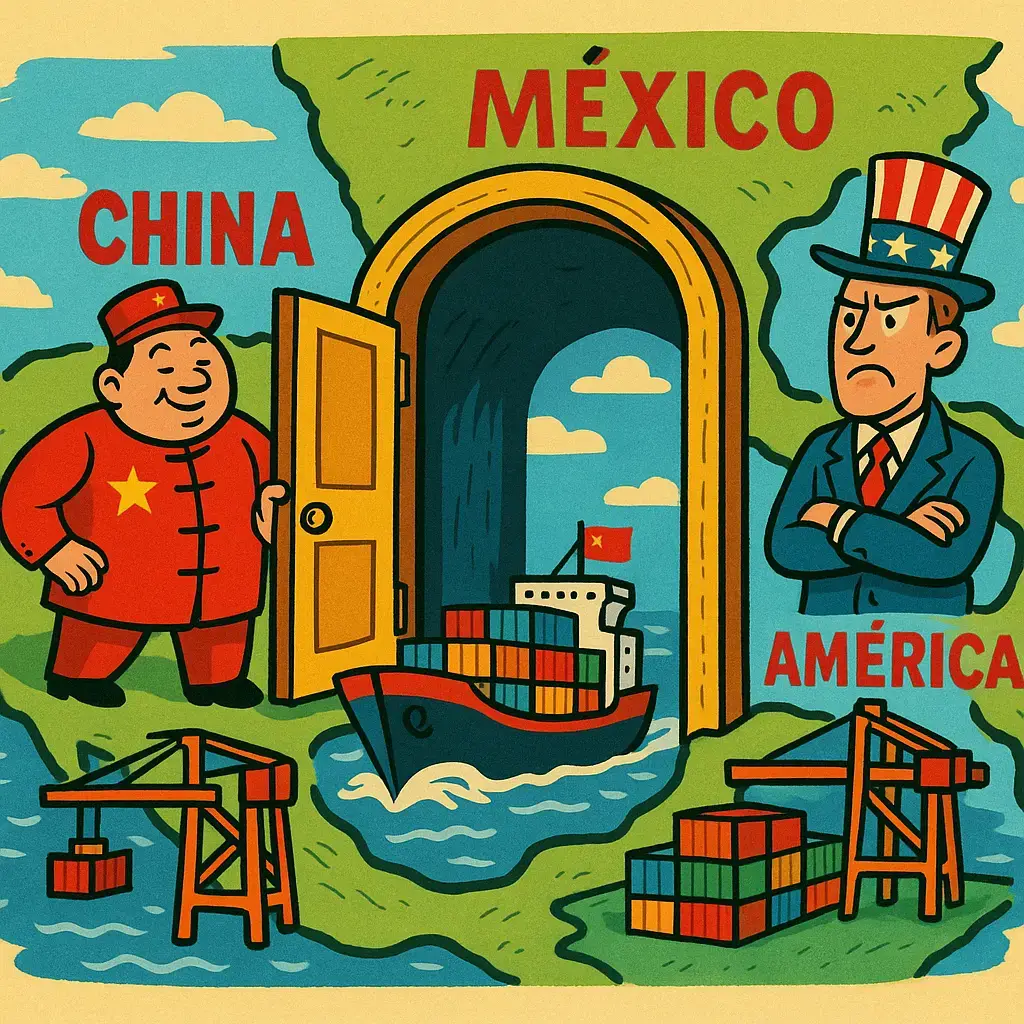
China's back door into the Americas: Mexico and the hidden battle for the future of global trade
While the West watches Ukraine, Gaza or Taiwan, a quiet but colossal transformation is taking shape along Mexico's Pacific coast. No missiles, no headlines, no prime-time diplomatic crises. Just ships. Ships loaded to the gunwales that sail from Shanghai and, without calling at California or transiting the Panama Canal, dock directly at the port of Manzanillo.
On the surface, it is just trade. Underneath, it is a surgical maneuver by Beijing to reshape the balance of power on the continent.
China has not invaded the Americas. It does not need to. It is enough to redraw the routes of global trade. And it is doing so through a channel that until recently did not appear on Washington's strategic maps: Mexico. In particular, a nerve center where the Pacific becomes a revolving door into the continent's logistics heartland: the port of Manzanillo.
Here, far from the media noise, a war without gunfire is being fought for control of the 21st century. A war of infrastructure, logistics and geoeconomics. And Mexico, without fully intending to but without avoiding it either, has become the new pivot where two giants collide: the United States and China.
The great leap: Shanghai–Manzanillo, the new American Silk Road
A ship leaves Shanghai and, against all traditional logic, bypasses Los Angeles and the iconic Panama Canal. It sails straight to Manzanillo, Mexico, saving up to ten crucial days of sea transit. This is not fiction; it is the new reality of global logistics.
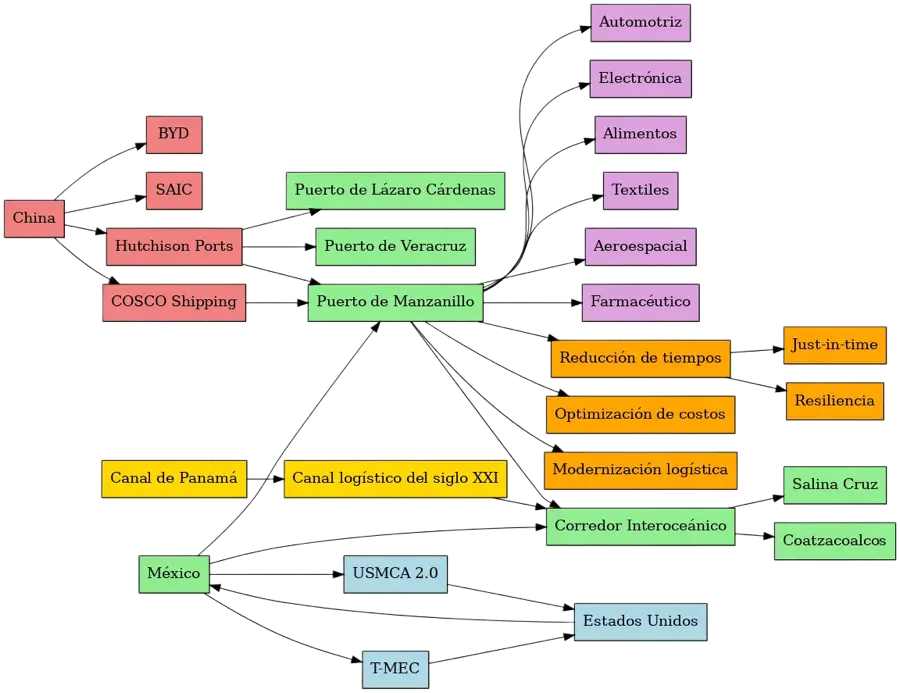
In 2023, China consolidated a massive $2.7 billion investment to turn the port of Manzanillo into the largest container port in Latin America. By 2030, the terminal will be able to handle 10 million TEUs a year, a capacity comparable to the historic port of Los Angeles. The company behind the operation is Hutchison Ports, a Hong Kong giant that already runs several ports in Mexico, from Lázaro Cárdenas to Veracruz, building out genuine Chinese infrastructure on Mexican soil.
- $2.7B
- of Chinese investment to transform the port of Manzanillo (2023)
The hidden power of the Interoceanic Corridor
The most ambitious project complementing China's bet is the Interoceanic Corridor of the Isthmus of Tehuantepec. This megaproject aims to connect the Pacific and the Atlantic in just six hours, through electrified railways, state-of-the-art highways and advanced ports at Salina Cruz and Coatzacoalcos. It is expected to attract investment of close to $50 billion and create up to 550,000 direct jobs.
Mexico's geography is about to become a strategic bridge, not only commercial but political too. By drastically reducing dependence on the Panama Canal, Mexico could change the map of intercontinental trade, directly benefiting key industries such as automotive, electronics and agriculture.
| Indicator | 2023–2025 figure | Notes |
|---|---|---|
| China–Mexico bilateral trade | $100.2–110 billion | 6–15% annual growth |
| Chinese exports to Mexico | $81.56 billion | Mainly electronics, machinery, cars |
| Mexican imports from China | $129 billion | Record high in 2024 |
| Mexican exports to China | $9.932 billion | Significant trade deficit |
| Container growth (TEUs) | +20% at Manzanillo, +60% overall | Manzanillo as a strategic hub |
| Lower logistics costs | Up to 30% | Thanks to direct sea routes |
| Shorter transit times | Up to 10 days less | Versus routes via Panama or the US |
| Chinese direct investment in Mexico | $282 million (2022) | +32% on the previous year |
| Sectors that benefit most | Automotive, electronics, energy, ICT | Technology transfer and jobs |
| Jobs created by port modernization | Thousands of new jobs | Regional and logistics development |
China and Mexico: a trade romance with striking numbers
In figures, the trade relationship between China and Mexico is dizzying:
- $110B
- in China–Mexico bilateral trade in 2023
- $81.56B
- in Chinese imports: electronics, machinery, vehicles and plastics
- +60%
- annual growth in container traffic
- 117,000
- TEUs a month reached in 2023
The trade romance, in figures.
China has also rapidly displaced other players in strategic sectors such as automotive. Brands such as BYD and SAIC have already captured 20% of the Mexican car market, setting up plants in strategic regions to take advantage of the USMCA and lower the tariffs they pay when exporting to the United States.
| Measure/event | Detail/impact | Source/comment |
|---|---|---|
| US tariffs on Mexico | 25% on all Mexican imports (March 2025) | Except hydrocarbons |
| US tariffs on China | 20% on Chinese goods, on top of existing ones | Impact on inflation |
| Chinese tariffs on the US | Up to 84% on US products | Trade retaliation |
| Impact on consumer prices | Every 10% of tariff = +4% in final prices | Global inflation |
| Mexico's strategy | Deeper integration with the US and Canada (USMCA) | Plan México |
| Further US threats | 100% tariff on Mexican cars with Chinese parts | Risk for the automotive sector |
| Mexico's response | Retaliatory tariffs on the US, review of tariffs on China | Diplomatic tension |
Shorter transit times have a deep, positive impact on the supply chain, across several key areas:
- Greater efficiency and competitiveness: when goods take less time to reach their destination, companies can respond faster to market demand, which makes them more agile and competitive.
- Lower operating costs: shorter transit times make it possible to optimize inventory, cut storage costs and minimize the expenses associated with delays or disruptions in the supply chain.
- Higher customer satisfaction: faster, more predictable deliveries increase customer satisfaction, strengthen loyalty and improve the company's reputation.
- Inventory optimization: with shorter delivery cycles, companies can adopt leaner inventory strategies (such as just-in-time), which reduces tied-up capital and the risk of obsolescence.
- Lower risk of shortages and greater resilience: speeding up the flow of products reduces the likelihood of stockouts and improves the ability to respond to the unexpected or to demand spikes.
- Smaller carbon footprint: faster, more efficient routes can reduce resource consumption and the emissions associated with transport and storage, contributing to sustainability.
- Better visibility and control: faster processes and tracking technologies give greater control over every stage of the supply chain.
Nearshoring, assembly and collateral risks
Chinese investment in Mexico is not only about selling products; it has also built a complex local assembly system that lets Chinese companies export to the US under the USMCA's preferential terms. But this strategy is not without risks and challenges:
- Port congestion
- Manzanillo and other ports face critical saturation, driving up costs and causing significant delays that hit industries such as automotive, technology and agriculture.
- Geopolitical tension
- The United States is watching with growing unease as its southern neighbor becomes a key link in China's strategy, seeing Mexico as a possible “back door” for getting around its trade and security controls.
- Volatile logistics costs
- Sea and land freight rates have soared, creating uncertainty and strain across global supply chains.
- Security
- Foreign control of ports also raises concerns about maritime intelligence and the illicit trafficking of dangerous substances such as fentanyl precursor chemicals.
The collateral risks of the new corridor.
The benefits for Mexico what the route brings in
- Economic growth driven by logistics investment.
- Large-scale job creation and regional development.
- A privileged geostrategic position between two oceans.
The deeper risks what is accepted in return
- Potentially growing debt to Chinese banks.
- Gradual loss of control over strategic infrastructure.
- Tension with Washington and tougher USMCA rules.
Mexico's challenge, with both sides in view.
And deeper risks:
- Potentially growing debt to Chinese banks.
- Gradual loss of control over critical national infrastructure.
- Vulnerability to future geopolitical disputes.
Future scenarios
The new direct sea route between China and Mexico is driving a profound transformation in international logistics. Its main logistics benefits are:
- Significantly shorter transit times: by avoiding longer traditional routes, such as those through the Panama Canal or congested US ports, shipments can arrive up to ten days earlier, speeding up the flow of goods and allowing a more agile response to market demand.
- Optimized logistics costs: the direct route reduces transport costs, both through lower sea freight rates and through fewer expenses for storage and delays at intermediate ports. That translates into more competitive final prices for imported and exported products.
- Greater cargo capacity: sea freight is ideal for large volumes of goods. Ships on the new route can carry a wide range of products, including heavy machinery, cars, electronics and raw materials, which benefits key industrial sectors.
- Modernized port infrastructure: the expansion and modernization of Mexican ports such as Manzanillo has improved operational efficiency, cutting unloading times and making it easier to handle large container volumes.
- Better logistics connectivity: the new route encourages supply chain integration, eases access to global markets and diversifies logistics options, increasing resilience to disruptions on other traditional routes.
- Greater flexibility and adaptability: route diversification lets companies choose the most efficient option at any given time, adapting quickly to changes in demand, logistics prices or operating conditions.
- A boost to regional integration: stronger connectivity between Mexico and China supports Latin America's integration into global trade, opening up opportunities for exporters and importers across the region.
In short, the new China–Mexico sea route brings key advantages such as lower times and costs, greater capacity and flexibility, port modernization and better regional logistics integration, positioning Mexico as a strategic node in transpacific trade.
- Positive scenario: Mexico emerges as a key logistics hub, thriving on investment and building a solid homegrown industry that makes strategic use of its geographic position.
- Negative scenario: the United States imposes harsh sanctions and tariffs, triggering a deep economic crisis that could hurt regional growth.
- Balanced scenario: Mexico proactively negotiates a new trade agreement with the US and Canada (USMCA 2.0), securing specific clauses that limit the risks tied to Chinese investment.
Not to be overlooked: Mexican lithium in China's renewable energy supply chain
Mexico holds one of the largest lithium deposits in the world, located in Sonora and known as the “Lithium Valley”, with estimated reserves of more than 243 million tons. This resource is essential for manufacturing rechargeable batteries, electronic devices and electric vehicles, and for renewable energy storage, sectors in which China is the global leader in both processing and battery production.
The relationship between Mexico and China in the lithium sector
- Chinese interest: through companies such as Ganfeng Lithium, China had obtained concessions to mine Mexican lithium, seeking to secure supply for its battery and clean energy industry. The goal was to export Mexican lithium to Asia, especially China, to feed the electric battery value chain; China produces close to 90% of the world's batteries.
- Concessions canceled: in 2023–2024, the Mexican government canceled several concessions held by Chinese companies, citing unmet investment commitments and seeking greater national control over the strategic resource. This has created uncertainty about the future of direct exports of Mexican lithium to China.
- Nationalization and new plans: Mexico nationalized lithium in 2022 and is now pushing policies so that mining and processing mainly benefit the local economy, while remaining open to foreign investment to develop a battery industry in the country.
Impact on China's renewable energy supply chain
- Before nationalization: Mexican lithium was set to feed into the global battery supply chain, especially in China, where it would be processed and used to manufacture batteries for electric cars, electronic devices and renewable energy storage systems.
- Today: after the concessions were canceled and lithium was nationalized, the direct flow of Mexican lithium to China has stopped or slowed considerably. China is still keen to regain access to these deposits, but Mexican policy prioritizes national development and attracting investment to manufacture batteries in Mexico, with Chinese and Korean companies taking part in local plants.
- Joint projects: Mexico has announced Chinese and Korean investment to build battery production plants in the country, which could allow part of Mexico's lithium to be used in locally made batteries, some of which could be exported to China or fed into global clean energy supply chains.
| Stage/chain | Situation up to 2022–2023 | Current situation (2024–2025) |
|---|---|---|
| Lithium extraction | Concessions to Chinese companies (Ganfeng) | Nationalization, Chinese concessions canceled |
| Processing | In China, after the ore is exported | Mexico seeks to process locally with foreign investment |
| Battery production | Mostly in China | Plants planned in Mexico with Chinese/Korean partners |
| End use | Batteries for electric cars, renewables | In Mexico and for export; possible partial integration into the Chinese chain |
... the battle for the Americas has only just begun
The global chessboard has been quietly rearranged. While the world was distracted, China had already rolled out its strategy in the Americas, placing Mexico at the center of the economic and geopolitical war that will define the coming decades.
The port of Manzanillo, once just another dot on the map, is now a hub of global influence. Mexico stands on the brink of a historic transformation, full of both opportunities and threats.
| Risk/opportunity | Description |
|---|---|
| Opportunity for Mexico | An edge over Asia thanks to exemption from the initial US tariffs |
| Risk of retaliation | China and the US may escalate measures, hurting Mexican exports |
| Uncertainty for investors | Geopolitical tension and volatile trade rules |
| Pressure to scale back ties with China | The US demands limits on Chinese investment and tougher rules of origin |
This is the new reality: the American Silk Road is already a fact. Brace yourself, because this century will bring trade and political battles that will change everything we know.
The opening of direct sea routes between China and Mexico is transforming bilateral and regional trade, benefiting certain productive and logistics sectors in particular. The sectors getting the most out of this new connectivity are:
- Automotive and auto parts: imports of car parts and complete vehicles from China have grown significantly. Mexico is one of the main destinations for Chinese cars, and many companies are using the shorter times and lower logistics costs to supply local and export-oriented industry.
- Industrial machinery and equipment: shipping heavy, high-value machinery is one of the main uses of the new route, supporting the modernization and expansion of Mexican manufacturing.
- Electronics and information technology: the electronics and technology components sector benefits from fast, secure delivery, which is crucial for just-in-time supply chains and for assembly at Mexican plants serving the North American market.
- Agribusiness and processed food: being able to ship perishables more safely and in less time favors exporters and importers of cereals, processed food and agricultural products, easing their integration into global value chains.
- Chemicals and plastics: trade in chemicals and plastics has found an efficient channel in the new route to supply Mexican and regional industry, with less risk of delays and spoilage.
- Textiles, clothing and accessories: the textile and apparel industry has also benefited, especially from the faster arrival of inputs and finished goods for the Mexican and export markets.
- Base metals and minerals: shipping minerals and base metals from China to Mexico is another key sector making use of the new sea connectivity.
- Furniture and toys: these sectors, traditionally dependent on Asian imports, benefit from shorter transit times and lower logistics costs.
- Pharmaceuticals and healthcare products: shorter delivery times matter especially for pharmaceutical and medical products, where speed and traceability are critical.
- Aerospace: Mexico, with a growing aerospace sector, also benefits from the faster arrival of specialized components and equipment.
| Sector | Main benefit |
|---|---|
| Automotive and auto parts | Fast supply, export integration |
| Machinery and equipment | Industrial modernization, lower costs |
| Electronics/IT | Assembly and export, just-in-time chains |
| Agribusiness/food | Safe, fast transport of perishables |
| Chemicals and plastics | Efficient supply for manufacturing |
| Textiles and fashion | Faster inputs and finished goods |
| Metals and minerals | Steady flow of raw materials |
| Furniture and toys | Shorter times and lower logistics costs |
| Pharmaceuticals | Speed and traceability for sensitive products |
| Aerospace | Specialized components in less time |
In conclusion, the new China–Mexico route is energizing bilateral and regional trade, with direct, positive effects on the automotive, industrial, agri-food, chemical, electronics and textile sectors, among others, consolidating Mexico as a key logistics node for trade between Asia and the Americas.
Related service
Threat intelligence and threat analysis