Wars are not won with nuclear bombs, but with plastic
By Kike Gandia · Defense & Geopolitics · 6 min read
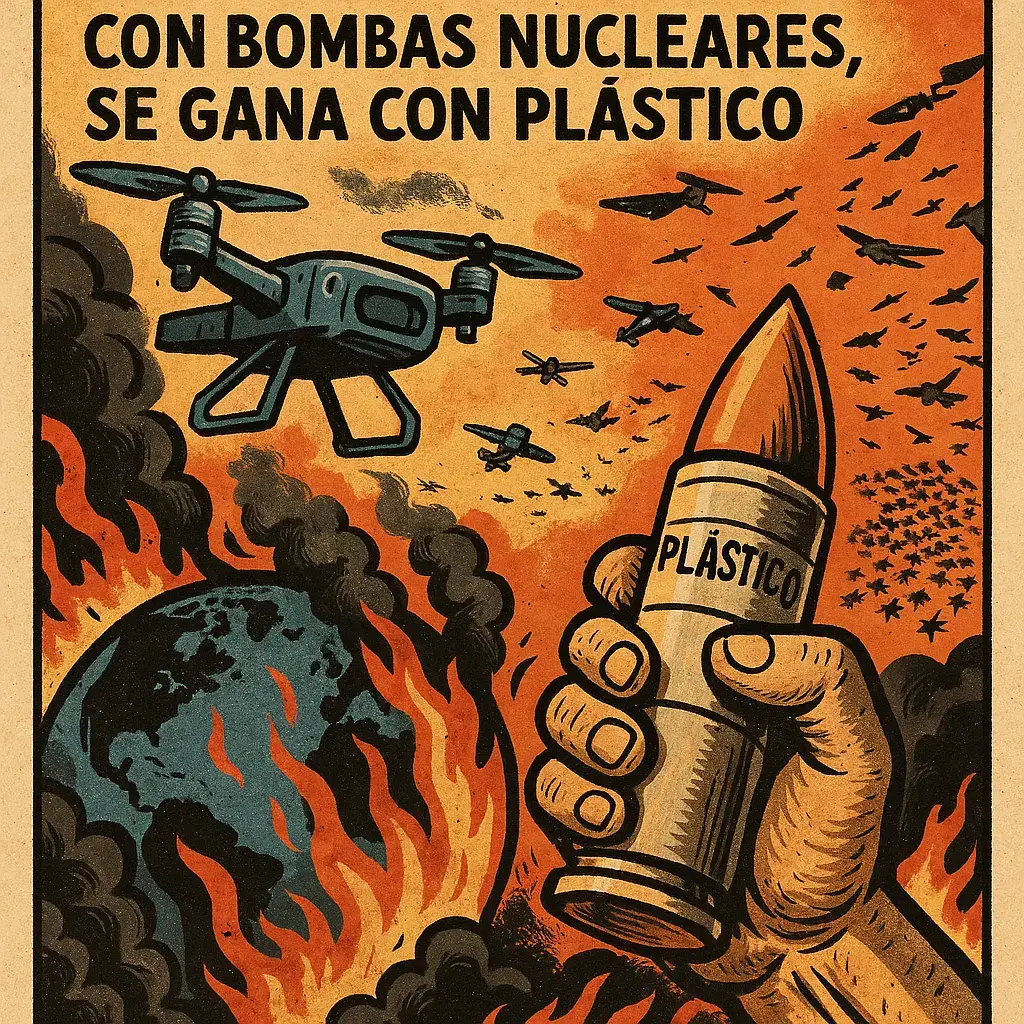
For decades, the great powers have built their military hegemony on two pillars: nuclear terror and technological supremacy. Radar-evading aircraft, nuclear submarines, aircraft carriers that are floating cities. But while the world was obsessed with the spectacle, a silent revolution was brewing in factories, industrial parks and 3D printing rooms. A revolution that needs neither plutonium nor quantum chips. One that does not seek to destroy entire cities, but to saturate the skies with kamikaze drones and polymer munitions. Welcome to the age of cheap, replicable and autonomous warfare. Welcome to mass-produced conflict.
Because what we are seeing is not just a new phase of modern warfare: it is the emergence of a multi-mosaic paradigm, in which multiple conflicts — economic, territorial, cyber and narrative — intertwine and collide in real time. A decentralized model of warfare, in which tactical and operational decisions are no longer delegated to humans alone.
The United States has begun delegating critical functions to autonomous systems, from target analysis to threat selection, in high-speed operations where human latency becomes a structural disadvantage. And although nuclear weapons are still the “final button”, more and more of the decisions that come before it — such as aiming, tracking or launching defensive missiles — are handled by software. The risk is not only technical: it is strategic, because it poses a new power dilemma. Who dominates when dominance depends on automation?
Plastic and silicon have become the new strategic reserves. But unlike uranium, they do not need to be controlled by international treaties: they only need to be produced at scale.
The factory as the new battlefield
In this war, the winner is not whoever has the biggest bomb, but whoever can manufacture more, faster and cheaper. What used to be technological advantages are now logistical advantages. While a ballistic missile costs millions, an explosive-laden FPV drone can cost as little as €100. And even more importantly: it can be manufactured by the million, without relying on complex supply chains or strategic materials.
In 2024, Ukraine manufactured 2.2 million FPV drones for its defense, an unprecedented industrial leap for a country at war. Turkey, for its part, has become one of the world's largest exporters, placing its TB2s in conflicts across Africa, Asia and Eastern Europe. Each unit costs $5 million, a bargain compared with the US MQ-9 Reaper, valued at $20 million. It is the democratization of air warfare. You don't need to be a superpower; you just need to assemble
| Indicator | Value | Source |
|---|---|---|
| Average cost of FPV drones | €100 – €400 | [5][6] |
| Annual FPV drone production in Ukraine | 2.2 million | [5] |
| Turkish drone exports | 25% of the global market | [4] |
| Cost of Turkish TB2 vs MQ-9 Reaper | $5M vs $20M | [4] |
From gunpowder to polymer: tomorrow's bullets weigh less and cost less
But the equation does not end in the air. On the ground, munitions are changing too. So-called “plastic bullets” are no longer made of rubber, nor are they used only for riot control. These are polymer-tipped military rounds: lighter, cheaper and highly lethal. Originally designed for hunting, they deform on impact and cause devastating trauma without the need for large calibers. They also do not corrode, which makes them the perfect choice for long-term storage and mass use.
According to ballistics experts cited by La Razón and Cinegeticat, these rounds weigh 30% less than copper ones, are compatible with 3D printing systems and can be produced by the million. They are ideal for armed drones, light armies and conflicts where speed of production matters more than sophistication. They are, in short, the ammunition of the new paradigm of warfare.
China is not watching. It is producing.
While the rest of the world debates AI ethics and the limits of autonomous warfare, China is manufacturing the war of the future. Not in a secret lab, but across its industrial base. In 2022, the country produced drones worth €15 billion, leading with 70% of the consumer market and 50% of the industrial market. In the first half of 2024, 608,000 new drones were registered, logging almost 10 million flight hours. The infrastructure is no longer military; it is civilian. And the military only has to build on top of it.
| Indicator | Value | Source |
|---|---|---|
| Drone production (2022) | €15B | [2] |
| Drones registered in 2024 | 608,000 UAVs | [4] |
| Cumulative flight hours | 9.82M | [4] |
The low-altitude economy: saturation from the sky
The Chinese government has named this strategy the low-altitude economy. It is a new economic sector focused on urban air mobility, logistics, surveillance… and yes, war. The goal is to exceed $137 billion in 2026, building the infrastructure for autonomous drones to live alongside us the way cars do today.
This is not simply innovation. It is a doctrine. A bet on saturating the sky with millions of aerial nodes. Each one autonomous, low-cost and weaponizable if needed. The swarm as public policy.
| Indicator | Value | Source |
|---|---|---|
| Economic projection | +$137B (2026) | [8] |
And if you have plastic, you have power
None of this would be possible without a detail many people overlook: plastic. China is a superpower in plastics production, generating 69.866 million tonnes in 2024, with exports of more than $100 billion. If a country can turn plastic into weapons at scale, it has the power to convert its civilian economy into a war machine.
| Indicator | Value | Source |
|---|---|---|
| Plastics production (2024) | 69.866M tonnes | [1][7] |
| Exports (2023) | $100,809M | [1][7] |
| Growth 2020–2024 | 5.14% per year | [1][7] |
Swarm warfare: saturation as doctrine
On the front line, the effect of this strategy is already tangible. In Ukraine, the use of FPV drones has increased the number of UAV units deployed per year sevenfold. The swarm economy is up and running. And the cost per attack is brutally asymmetric: while Russia spends $18 million on its attacks with Iranian drones, Ukraine needs $28 million to defend itself. War is now measured in military ROI
| Indicator | Value | Source |
|---|---|---|
| Increase in UAV crews | x7 in one year | [5] |
| Cost of drone attacks (Russia) | $18M | [6] |
| Cost of defense (Ukraine) | $28M | [6] |
The final logic: saturate, don't eliminate
Why destroy a tank if you can make sure it never moves again? Why send soldiers if you can overload every enemy radar with 300 drones at once? Why fire a €2 million missile if you can 3D-print 10,000 projectiles for a fraction of the cost?
| Indicator | Value | Source |
|---|---|---|
| Ballistic missile | $1–5M | [general] |
| Armed FPV drone | €100–400 | [5][6] |
| Polymer bullet | Cents | [1] |
The future of war is not in the nuclear button. It is in the production button.
Are we ready for cheap war?
China is not going to conquer the world with bombs. It will do it with drones, plastic and mass production. It will print its military doctrine the way it prints toys, processors and routers. In a conflict where saturating is more effective than annihilating, the capacity to manufacture becomes deadlier than the capacity to destroy.
The question is not whether these methods will be used. It is who will use them better, faster and more often.
So what now?
- Plastic is the new uranium. And the factory is the new military base.
- War is no longer science fiction.
- It is industry. And it is happening now
Want to get ahead of what's coming?
If you need to monitor threats, detect anomalies or get real-time intelligence on sectors, actors or critical situations,
QuantumLabs gives you full control of the board.
A private, modular and autonomous platform that turns scattered data into strategic decisions.
Connected, scalable and ready for the next war — whether economic, informational or industrial.
You decide what to watch. QuantumLabs takes care of the rest.
Related service
Cyber threat intelligence and threat analysis