The New War Casino: How People Are Betting in Real Time on the Military Advance in Ukraine
By Kike Gandia · Defense & Geopolitics · 6 min read
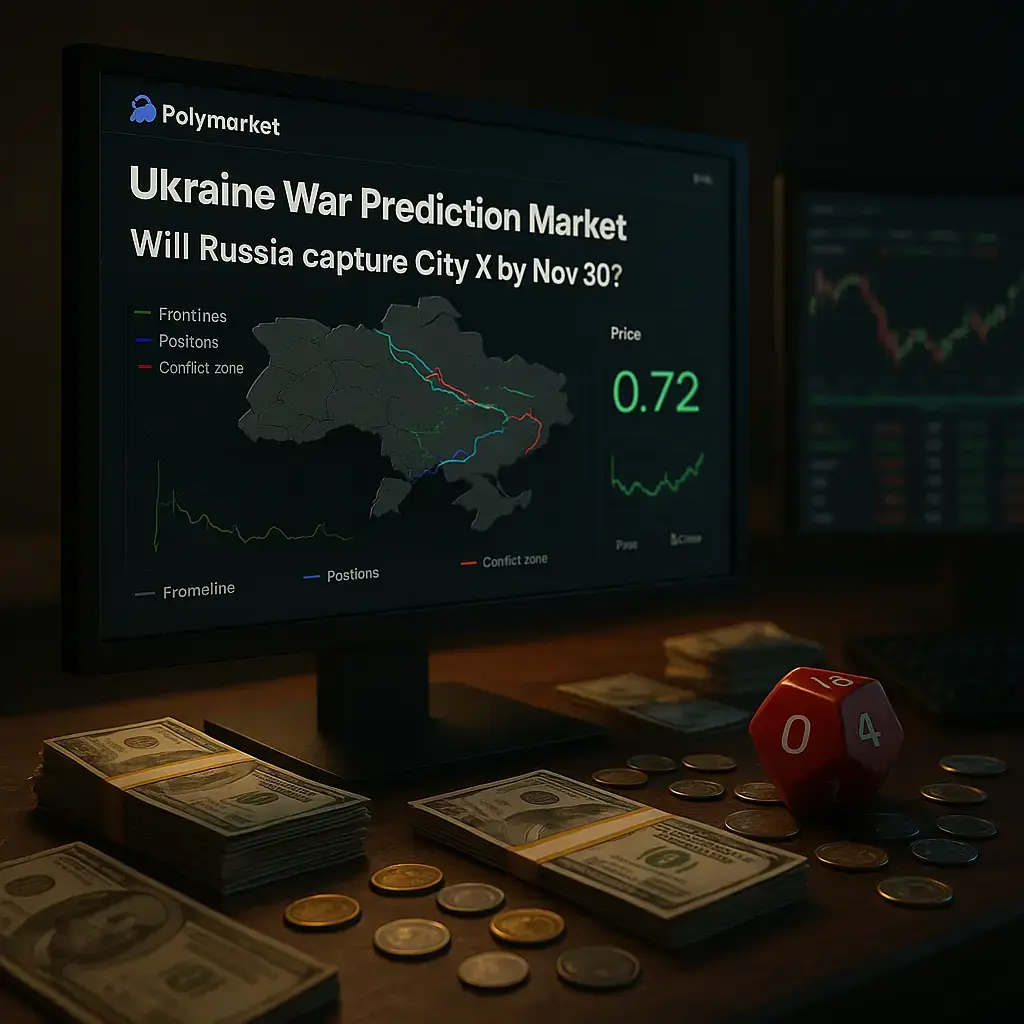
In 2025 it stopped being a metaphor: the war now has a market price
Every platoon advance, every street lost in Bakhmut, every kilometer gained by Ukraine or Russia has become a number that rises and falls like the price of a meme token. Platforms such as Polymarket have, for the first time, connected the Ukrainian front to a global market where anyone can speculate on which city will fall, which army will advance or which operation will be completed first.
What used to be pure OSINT — DeepStateLive maps, satellite reports, Telegram updates — now feeds a financial market that settles automatically according to what happens on the ground.
And yes: people are making money from it
How this global casino works
The mechanics are brutally simple.
Polymarket opens an “event”:
"Will Russia take city X before November 30?"
The system takes verified OSINT data
- Step 1 — Polymarket opens an “event”
A closed question with a deadline: will Russia take city X before November 30? - Step 2 — The system takes verified OSINT data
Confirmed lines of contact, geolocated positions, contested zones and satellite-verified advances. - Step 3 — Prices change in real time
Every meter gained shifts the market probability. - Step 4 — The market closes
If the city officially falls, those who bet correctly get paid. A trader in New York makes money because two buildings have changed hands in Avdiivka.
The total gamification of conflict: a militarized Wall Street where the front line turns into red and green candles.
Prices change in real time:
Every meter gained shifts the market probability.
If the city officially falls → the market “closes” and those who bet correctly get paid. It is the total gamification of conflict. A militarized Wall Street where the front line turns into red and green candles. A trader in New York can make money because two buildings have changed hands in Avdiivka.
A real case: the fall of Avdiivka
On February 17, 2024, Avdiivka fell to Russian forces after months of brutal siege.
On Polymarket, the contract "Will Avdiivka fall before March 1?" had been swinging for weeks:
| January 15 Skeptical speculators. | 35% |
| February 10 OSINT reports of a near-complete encirclement. | 62% |
| February 16 Confirmation of the Ukrainian withdrawal. | 89% |
| February 17 Avdiivka falls. The market closes. | 100% |
Probability assigned by the Polymarket contract “Will Avdiivka fall before March 1?”, week by week.
Those who bet $10,000 in January on the city falling collected $28,571 when the contract resolved. Behind that profit: an estimated 3,700 military casualties, 47,000 displaced civilians and a city reduced to rubble.
- $10,000
- bet in January on the city falling
- $28,571
- collected when the contract resolved
- 3,700
- estimated military casualties
- 47,000
- displaced civilians
The first two figures are the return on the trade. The next two are what lay underneath.
But in the market, only ticks matter, not lives.
The dark side: war turned into a financial asset
For their advocates, these markets work as a “social thermometer”, a form of collective intelligence able to anticipate reality better than any think tank.
For the rest of the world, it is an obvious dystopia. Because behind every swing on the chart there is something simple and terrible: people dying.
If Russia advances, the stock goes up. If Ukraine loses ground, traders celebrate a well-placed long. If a city holds out one more day, the “it won’t fall” speculators breathe a sigh of relief.
Analysts have a name for this: the financialization of human suffering.
The financialization of human suffering. If Russia advances, the stock goes up. If Ukraine loses ground, traders celebrate a well-placed long. If a city holds out one more day, the “it won’t fall” speculators breathe a sigh of relief. In the market, only ticks matter, not lives.
OSINT turned into a speculative commodity
Until a few years ago, OSINT maps were used to understand the war, not to bet on it. Yet tools such as DeepStateLive, the ISW (Institute for the Study of War) or Telegram channels such as Rybar have been absorbed into this speculative ecosystem.
And this is where a new risk emerges: information manipulation with financial incentives.
If a fake photo of a military advance pushes a contract up, someone can make money. If a rumor sinks a position, someone will have used it to go short. If a state actor wants to shape international perception, it can do so by moving these markets.
Information warfare — already toxic in itself — now comes with a price tag.
The oracle problem
In blockchain terms, an “oracle” is the system that verifies which outcome is correct in order to settle a smart contract. In these war markets, oracles usually rely on:
What the oracle relies on what settles the contract
- Official government confirmations.
- Reports from “reliable” media (Reuters, AP, BBC).
- OSINT maps from specific platforms.
- Manual verification by Polymarket moderators.
Where it breaks every point with money behind it is a target
- A convincing deepfake of an official statement sends the market soaring before it is debunked.
- A DDoS on DeepStateLive at critical hours paralyzes verification.
- A coordinated campaign creates the illusion of consensus about an event that never happened.
- Every point can be attacked, manipulated or delayed.
The problem: every one of these points can be attacked, manipulated or delayed.
A convincing deepfake of an official Ukrainian statement could send a market soaring before it is debunked. A DDoS attack on DeepStateLive during critical hours could paralyze verification. A coordinated social media campaign could create the illusion of consensus about an event that never happened.
In security, any system with money involved immediately becomes a target.
Regulation: a perfect vacuum
Authorities in several countries have warned that betting on real wars comes dangerously close to illegal territory.
In Germany, the GGL (Gemeinsame Glücksspielbehörde) already considers these bets unlawful, classifying them as “contrary to human dignity”.
In the United States, the CFTC (Commodity Futures Trading Commission) fined Polymarket $1.4 million in 2022 for operating unregulated prediction markets. The company committed to blocking US users... but VPNs and crypto wallets make that restriction essentially cosmetic.
In the European Union, there is still no specific framework for war events on decentralized prediction markets.
- Germany Unlawful on grounds of human dignity
- The GGL (Gemeinsame Glücksspielbehörde) already considers these bets unlawful and classifies them as “contrary to human dignity”.
- United States Sanctioned, but still operating
- The CFTC fined Polymarket $1.4 million in 2022 for operating unregulated prediction markets. The company committed to blocking US users, but VPNs and crypto wallets make that restriction cosmetic.
- European Union No framework
- There is still no specific framework for war events on decentralized prediction markets.
The regulatory vacuum is total, while the market becomes global, anonymous and crypto-fueled.
The regulatory vacuum is total. Meanwhile, the market is becoming global, anonymous and crypto-fueled.
Financial incentives are being built around the conflict without any ethical filter or effective oversight.
What does this say about the world we are building?
This is where the dystopia becomes explicit.
Users — many of them traders, crypto speculators and the merely curious — “trade” the war just as they trade meme tokens: with volatility, hype, rumors, panic and greed.
The battlefield is no longer just a military theater: it is a trading interface.
War turned into a dashboard.
Tragedy turned into opportunity.
Death turned into a liquid contract.
And most disturbing of all: nobody is stopping this. Quite the opposite — it is growing.
Polymarket processed more than $3.2 billion in volume during 2024, a significant share of it tied to geopolitical and military events. New platforms keep emerging: Manifold Markets, Kalshi, Augur v2, each looking for its niche in this market for wartime uncertainty.
- $3.2B
- in volume processed by Polymarket in 2024 (a significant share of it on geopolitical and military events)
- $500,000
- in contracts a single deepfake can move (this is no longer disinformation: it is financial fraud)
Why this matters for cybersecurity and OSINT
For security professionals — such as the team at QuantumSec — this phenomenon opens up debates without precedent:
1. Manipulation at scale
These markets create artificial incentives to fabricate or amplify disinformation. A deepfake that moves $500,000 in contracts is no longer just disinformation: it is a financial fraud vector.
2. New vectors of state influence
Foreign powers could move money strategically to shape global perception. If the market believes Ukraine is losing, that affects morale, international aid and political decisions. An adversary with enough resources could manipulate these markets as part of a psychological warfare operation.
3. Attacks on oracles and OSINT sources
The infrastructure that decides the “official outcome” is already a target. Compromising DeepStateLive or the verified accounts of OSINT analysts could generate millions in illicit profits.
4. Risks to open-source intelligence platforms
Tools built to inform are being used to bet on chaos. Some OSINT projects have already started implementing countermeasures:
- Countermeasure Watermarking geographic data
- Marking provenance so that a stolen map can be traced.
- Countermeasure Intentional delays
- Deliberately delaying the publication of critical information so the market does not run ahead of the ground.
- Countermeasure Multi-source verification
- Not confirming a change of territorial control until several independent sources agree.
What some OSINT projects are already implementing: tools built to inform are being used to bet on chaos.
The final question: how long before this model is exported to other conflicts?
When a mechanism works economically, it gets replicated. When something generates speculation, it multiplies. When a new kind of market appears, it attracts shadows.
If today people are betting on Ukraine... what is to stop the same thing happening tomorrow in Gaza, Taiwan or the Sahel?
The technology already allows it. The incentives are already here. The ethical problem remains unresolved.
In fact, there are already active contracts on:
- Military escalation in the Taiwan Strait
- Military intervention in Yemen
- Coups d’état in West Africa
- Drone attacks on critical infrastructure
The model is not experimental. It is functional, profitable and expanding.
Related service
Cyber threat intelligence and threat analysis
Topics
#Cybersecurity #Military-strategy #Asymmetric-warfare #Military-technology
Keep reading
- The digital grenade in cyberwarfare: Neutralizing and jamming communications
- Multi-domain and mosaic warfare: the new US military thinking, by Guillermo Pulido Pulido
- Military jet falls into the Red Sea
- When dogs carry rifles: urban survival in the age of autonomous swarms
- Report on the J-20 Mighty Dragon fighter and Chinese military power | 2025