Military jet falls into the Red Sea
By Kike Gandia · Defense & Geopolitics · 11 min read
It is Monday, April 28, 2025, and the Red Sea, a strip of water that looks like the set of a war movie, sits in the eye of a geopolitical hurricane that threatens to change the world. An F/A-18E Super Hornet, a fighter jet valued at more than $60 million, has just gone overboard from the USS Harry S. Truman, an aircraft carrier the size of a floating city, armed with enough firepower to flatten a small country. It wasn't an enemy missile or spy-novel sabotage, but an absurd accident: the carrier made a hard turn to evade a possible drone and missile attack launched by the Houthis, the Iran-backed Yemeni rebels who have turned this shipping lane into a minefield. The tug towing the fighter lost control, and the aircraft, along with the tractor, slid across the deck and into the water, lost for good in an abyss more than 2,200 meters deep. The handlers jumped clear in time and one sailor came away with minor scrapes, but the damage goes far beyond a pile of expensive scrap metal. This accident is a crack in the system that underpins global trade, military security and the fragile balance of power in one of the most explosive regions on the planet. Welcome to the Red Sea in 2025: a powder keg where a single mistake can unleash an economic, financial and geopolitical tsunami.
The incident happened at a moment of maximum tension. The USS Harry S. Truman, the pride of the US Navy, was carrying out routine operations in the Red Sea when its radars picked up a credible threat: a possible attack by the Houthis, who that same day boasted of having targeted the carrier, its supply ship and several US destroyers. There is no evidence that they hit anything, but the threat was enough to force the captain to order an evasive turn, a standard maneuver in naval combat zones. The problem is that the F/A-18E was being towed inside the hangar bay, a delicate operation that demands pinpoint precision. The turn destabilized the tow, and in an instant the fighter, along with the tractor, went overboard. The loss is huge: a state-of-the-art aircraft, packed with sensitive technology, now lies at the bottom of a sea too deep for any realistic recovery attempt. Beyond the financial cost, the incident raises uncomfortable questions about the vulnerability of naval operations in high-pressure environments and the risk of military technology falling into the wrong hands if someone manages to fish out the wreckage.
This accident is not an isolated event but one piece of a puzzle that has been coming together for months. Since October 2023, the Houthis have turned the Red Sea into their deadly playground. They control much of the Yemeni coast and, armed with an arsenal of cheap drones and ballistic and cruise missiles supplied by Iran, they have attacked more than 190 ships, from oil tankers to cargo vessels that have nothing to do with their supposed targets. They claim their attacks are aimed at Israel-linked ships, in solidarity with the conflict in Gaza, but in reality they fire at almost anything that floats, sowing chaos on a route that is vital to global trade. In early April 2025, the Houthis raised the stakes by claiming attacks on the USS Harry S. Truman and its escort, showing they are not afraid to challenge the most powerful navy in the world. Iran, like the friend who always shows up to a bonfire with a can of gasoline, provides them with technology, training and a frigate, the Alborz, that prowls the area, adding another layer of tension to a conflict already on the brink of escalation.
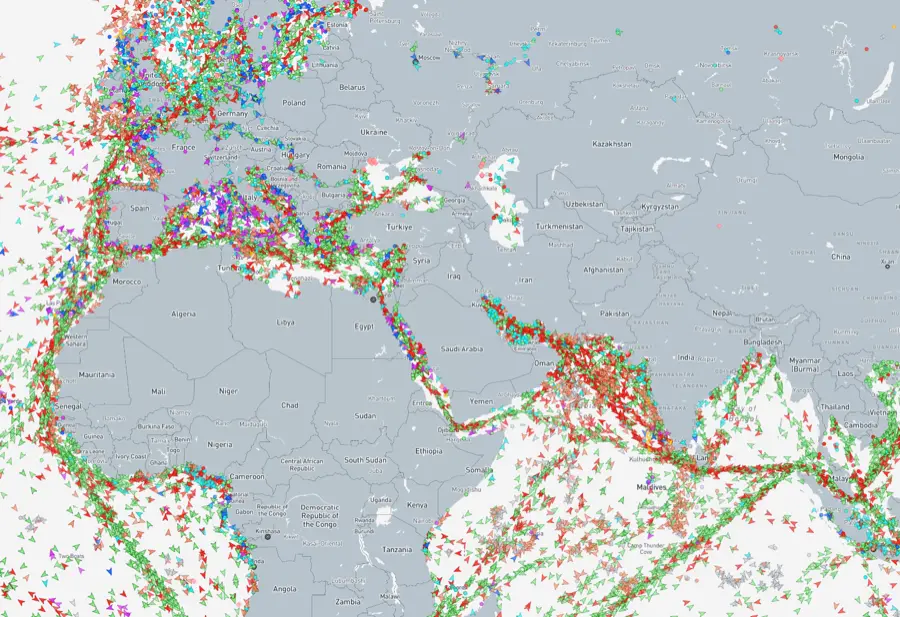
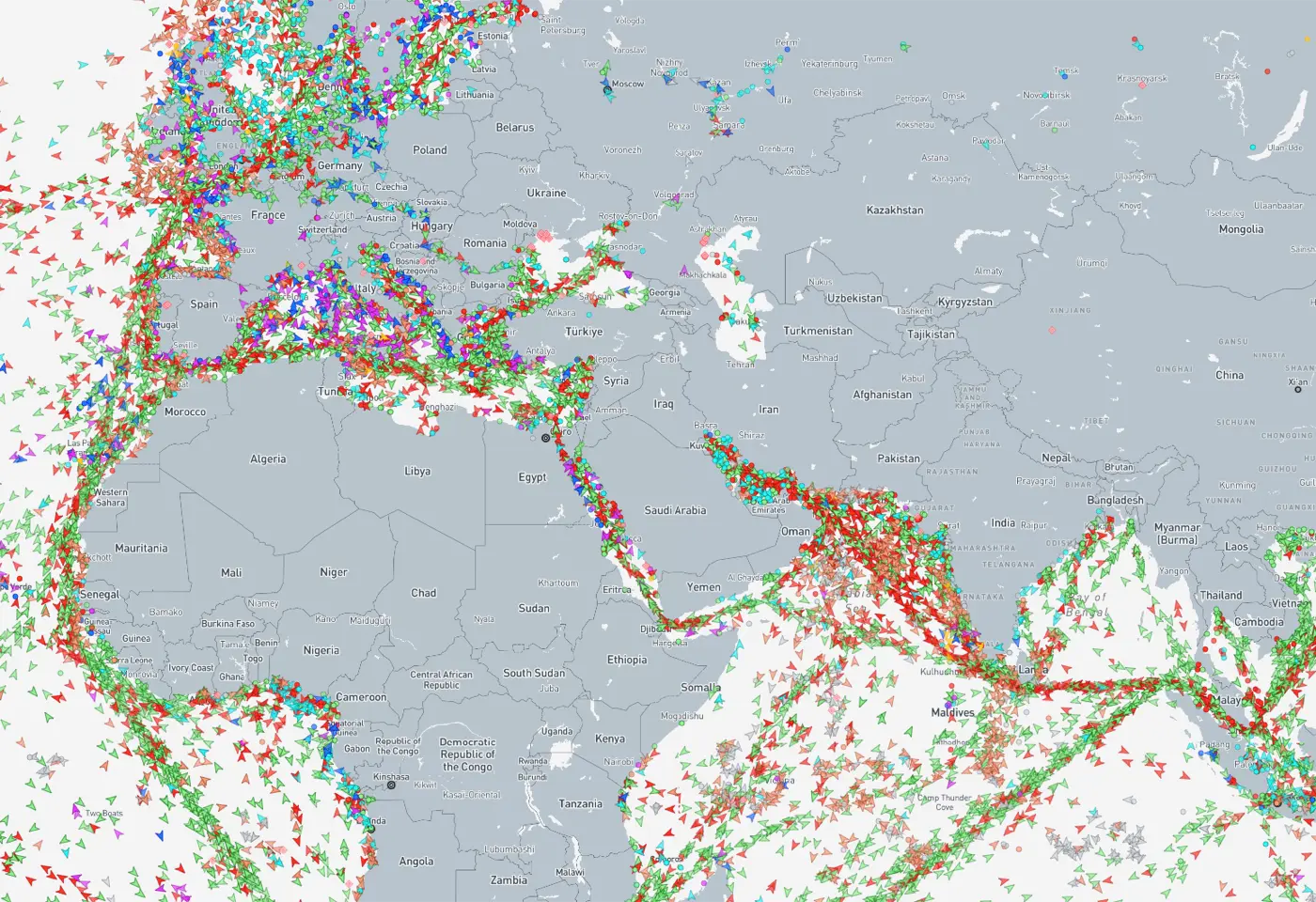
https://www.marinetraffic.com/en/ais/home/centerx:43.1/centery:27.7/zoom:4
The Red Sea is no ordinary puddle. It is a geostrategic artery that connects the Suez Canal to the Indian Ocean through the Bab el-Mandeb Strait, a passage so narrow that a single blockage can paralyze world trade. Between 12% and 15% of global trade moves along this route, including a third of the container traffic that keeps supply chains running, from iPhones in stores to wheat in supermarkets. It is also the route for the oil and natural gas that power the global economy, with up to 30% of the world's crude passing through on a good day. If the Red Sea closes, the world feels it: ports clog up, factories grind to a halt, shelves empty and prices shoot up. Since the Houthis began their offensive, shipping lines have said “no way” and are rerouting their vessels around the Cape of Good Hope, at the tip of Africa. That route adds up to 11,000 nautical miles and two weeks to the voyage, burns an extra million dollars in fuel per trip and is crippling supply chains. UNCTAD estimates that traffic through the Suez Canal has fallen 42%, and with the Panama Canal restricted by drought, there is no plan B. The result is a world where delays are the norm, costs are soaring and companies in every sector are sweating to stay afloat.
The Red Sea is more crowded than a summer music festival. The United States leads the charge with the USS Harry S. Truman and the USS Carl Vinson on its way, launching airstrikes on Houthi positions in Yemen as part of Operation Rough Rider, an effort the Navy describes as the most intense naval combat since World War II. The United Kingdom has joined the bombing campaign, while France, with its frigate Languedoc, and Greece, which intercepted drones in April, are shooting down threats as if it were a video game. Italy has the frigate Virginio Fasan on patrol, and India, worried about its merchant fleet, has deployed ten warships to escort its vessels. China, true to its role as the silent spectator, keeps an “anti-piracy” naval task group in the area that seems more interested in taking notes than in joining the fight. Israel operates missile defense systems in the northern Red Sea to block Houthi projectiles, and Iran, the great puppet master, has the frigate Alborz circling the area while it feeds the Houthis weapons and technology. It is a geopolitical chessboard where no one trusts anyone, and a single mistake could escalate the conflict to levels nobody wants to imagine.
- $60M
- cost of the F/A-18E Super Hornet that went overboard
- 190+
- ships attacked by the Houthis since October 2023
- 12–15%
- of global trade passes through the Bab el-Mandeb Strait
- 30%
- of the world's crude passes through the area on a good day
Why an accident in the Red Sea doesn't stay in the Red Sea.
The key players in the Red Sea
- The Houthis and Iran
- The Yemeni rebels, backed by Tehran, use asymmetric tactics to challenge global powers, turning cheap drones into weapons of chaos.
- The US and the UK
- They lead the military response, with aircraft carriers and airstrikes, but face the challenge of an enemy that does not play by the traditional rules.
- Europe
- (France, Italy, Greece): they contribute frigates and air defense, reflecting concern over the security of trade routes.
- India and China
- They protect their trade interests but avoid direct involvement in the conflict.
- Israel
- Focused on missile defense, but always on alert for the Iranian threat.
Who is playing in the Red Sea, and with what.
The crisis is hitting global trade like a hammer, and the effects are felt from the ports to the stock exchanges. Shipping lines such as Maersk, MSC, Hapag-Lloyd and Evergreen have rerouted their vessels around the Cape of Good Hope, accepting the delays and costs as the lesser evil. Each extra voyage burns a million dollars in fuel and adds up to two weeks, which cuts market capacity and causes cancellations and bottlenecks. Freight rates for 40-foot containers have risen by as much as 16% in a single week, and “war risk” surcharges are now a constant, even on routes that never touch the conflict zone. War risk insurance premiums for the few ships still crossing the Red Sea are prohibitive, and the extra costs are squeezing corporate margins. In Spain, 45.3% of industrial and energy companies report problems, while 41.9% of retail and trading companies are struggling. Automotive giants such as Tesla and Volvo have temporarily halted production in Europe because parts aren't arriving. Retailers such as Tesco, Marks & Spencer, Next and H&M in the United Kingdom are already warning that prices will rise, and chains such as Carrefour, Lidl and Inditex are struggling with half-empty shelves. Even the construction sector, which depends on imported materials, is feeling the squeeze.
The impact doesn't stop at ports and stores: it is reaching the stock markets, where uncertainty is making investors nervous. The Red Sea crisis is injecting volatility into the markets, and higher transport and energy costs are squeezing corporate margins. The threat of oil-driven inflation keeps central banks on alert, and the most exposed sectors, such as logistics, manufacturing and retail, are walking a tightrope. Shipping lines, although they are passing costs on to customers, face limited capacity and volatile demand that could hit their share prices. In industry, companies such as GM Technology are adapting, but those that rely on Asian supply, such as carmakers, are in trouble. Retailers, from H&M to Inditex, could see their margins eroded if costs don't come down soon. The energy sector, crucial for shipping oil and gas, is under pressure, with the potential to send global prices soaring if the attacks intensify. Even the defense sector could feel the impact. The F/A-18E accident has no documented direct effect on the stock market, but similar incidents have moved the needle in the past. When an F-35, another high-value aircraft, crashed, shares in BAE Systems, a key partner, fell, while Lockheed Martin, the prime contractor, wobbled on profitability concerns. The loss of the Super Hornet, built by Boeing, could raise questions about equipment reliability in high-pressure environments, although for now the market seems more worried about the bigger picture.
The sectors hit hardest by the crisis
- Logistics
- and shipping: shipping lines face astronomical costs and reduced capacity, with container transits through the Red Sea down 90%.
- Trade
- and retail: supermarkets and clothing stores are dealing with delays and higher prices, with a direct impact on consumers.
- Industry
- and manufacturing: factories, especially in the automotive sector, are stopping for lack of parts, affecting giants such as Tesla and Volvo.
- Energy
- Oil and natural gas shipments are at risk, with the potential to send global prices soaring.
- Construction
- Its dependence on imported materials leaves the sector in a vulnerable position.
Where the crisis hurts, sector by sector.
Shipping lines have rerouted their vessels around the Cape of Good Hope, trading time and money for safety. Some are trying hybrid solutions, such as combining sea freight with air or land transport, to meet delivery deadlines. Supply chains are being redesigned in a hurry: companies are looking to diversify routes, reduce their dependence on a single corridor and use technology to track every container as if it were an Amazon parcel. Companies such as Noatum Logistics are forming alliances with carriers that already have alternative routes, because in a crisis like this one, those who don't cooperate go under. But these are emergency fixes, patches on a system that was not built for a breakdown of this magnitude. Some companies are exploring “nearshoring” models to bring production closer to end markets, while others are investing in larger inventories to cushion the delays, even though that drives up storage costs.
The F/A-18E accident is more than a material loss. It is a warning of how fragile all of this is. Aircraft carriers are imposing war machines, but they operate under brutal pressure. A turn to dodge a drone can send an aircraft into the water, and a well-coordinated attack could exploit vulnerabilities nobody wants to admit. The possibility of hybrid warfare, in which the Houthis or their allies combine drones with cyberattacks on a carrier's systems, is not science fiction. It is a real risk that keeps military strategists up at night. The US Navy is investigating the accident, but don't expect it to admit that the system has cracks. Officially, the USS Harry S. Truman remains fully operational, a message designed to reassure allies and deter enemies. But the truth is that the Red Sea is no longer just a transit route. It is a turning point where asymmetric warfare, global trade and great-power rivalry meet in a dangerous dance.
The Red Sea is a microcosm of the world in 2025: a place where threats don't respect borders, where a group of rebels with second-hand drones can hold the global economy in check, and where an accident can be the spark for a bigger crisis. The Houthis are proving that you don't need a conventional army to wreak havoc; a handful of missiles and a strategy of chaos will do. Shipping lines, which only want to move goods, are trapped in a life-or-death game. Businesses, from factories to supermarkets, are rewriting their plans to avoid collapse. The markets, always quick to smell chaos, are starting to get nervous, and consumers, at the end of the chain, are about to feel it in their wallets. At QuantumSec, we are obsessed with untangling these connections, because security is no longer just a matter for soldiers. It is about keeping the world running when everything seems determined to stop it. The USS Harry S. Truman sails on, the Houthis keep firing, and global trade is reeling. The question is not whether there will be another crisis, but how long it will be before the next mistake takes us to the edge of the abyss.
Related service
Cyber threat intelligence and threat analysis
Topics
#Geopolitical-Context #Drones-and-Missiles #F-A-18E-Super-Hornet #Geopolitics #Naval-Geopolitics #Asymmetric-Warfare
Keep reading
- The New War Casino: How People Are Betting in Real Time on the Military Advance in Ukraine
- The digital grenade in cyberwarfare: Neutralizing and jamming communications
- Drone security: critical threats and how to protect airspace in 2025
- Operation Guacamaya | Checkmate to the Dictator: The Perfect Move
- Uncrewed submarines: the new hybrid threat in 21st-century naval warfare