When dogs carry rifles: urban survival in the age of autonomous swarms
By Kike Gandia · Defense & Geopolitics · 6 min read
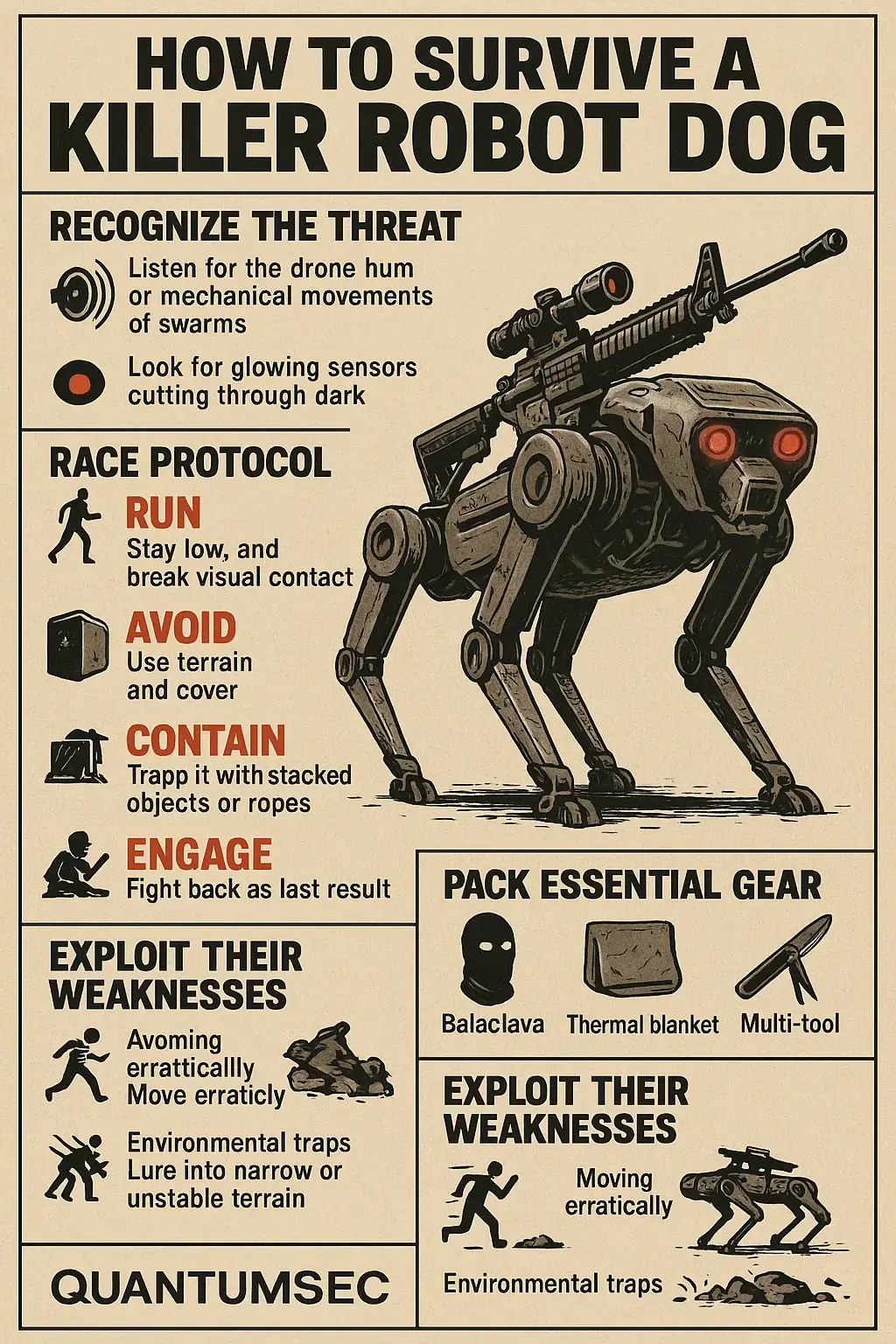
In the world's most volatile regions, these autonomous systems are already in active use. They don't bark, they don't reason and they feel no remorse. They move with algorithmic precision, stalk their targets using artificial intelligence and, when the moment comes, fire with mathematical lethality. We are talking about robotic combat dogs, a new class of autonomous quadruped systems built for surveillance, repression and the elimination of specific targets.
These are not lab prototypes: they are being deployed in real conflicts today. They are four-legged ground drones fitted with thermal vision, LIDAR sensors, swarm algorithms and lethal weapons mounted on the chassis. They are fast, they are stable, and they are already among us.
Anatomy of a threat: a technical profile of the enemy
- 50 kg TR4D-20
- Carries up to 70 kg of payload, reaches 4.95 m/s and runs for 4 hours unloaded or 2 hours loaded. Jumps 70 cm vertically and 1.5 m horizontally.
- 45.4 kg Ghost Robotics Vision 60
- 3 hours of endurance with thermal cameras, LIDAR and infrared sensors. Can be fitted with rifles, audio sensors and military communications modules.
- 15 kg Unitree Go2 / Thermonator
- Up to ~18 km/h and 10 kg of payload. Customized variants with mounted flamethrowers have been observed.
The three platforms already being deployed, with their specs.
Common systems
- Navigation: Autonomous and/or remote-controlled
- Detection: Facial recognition and body-heat tracking
- Communications: Encrypted, networked across multiple units
- Deployment environments: Urban areas, open terrain and hostile zones
The R.A.C.E. protocol: split-second decisions to survive
- R — RUN: get away, but avoid predictable paths
The robot's algorithm anticipates logical movements. Break its pattern: run in a zigzag, use changes in elevation, turn corners unexpectedly. "Human chaos" makes automated prediction harder. - A — AVOID: don't get detected
Their optical and thermal systems can track silhouettes and body heat. Use thermal blankets, break up your outline with irregularly shaped clothing and look for environments with a lot of "visual noise": cables, signs, lights that confuse the sensors. - C — CONTAIN: stop or slow their advance
Beating them by brute force is unrealistic; use your surroundings. Block stairways, obstruct corridors with furniture or rubble, and string taut ropes at different heights. Change the geometry of the space to buy time. - E — ENGAGE: confront them only as a last resort
If it is unavoidable, strike sensors or articulated joints with blunt tools. Try to disable any visible power sources. Bear in mind that they get back up on their own, recalculate quickly and will not hesitate. You need to confuse them to open a window to escape.
The R.A.C.E. protocol: four decisions in a matter of seconds.
Your surroundings as a shield: STOP MY HAT
Design or modify your spaces to make it harder for these robots to move and detect you. Each letter of "STOP MY HAT" describes a type of obstacle or advantage:
- S (Staircases): Narrow or blocked stairs make it hard for them to get through.
- T (Thin Gaps): Spaces under 40 cm are difficult or impossible to pass through.
- O (Open Holes): Gaps, trapdoors or false floors make controlled jumps difficult.
- P (Platforms): Movable surfaces (platforms, risers) destabilize their legs.
- M (Moving Surfaces): Elevators, conveyor belts or moving grates throw off their balance.
- Y (Yawning Gaps): Wide gaps demand a considerable jump that may fail.
- H (High Terrain): High ground with no immediate access offers a tactical advantage.
- A (Asymmetry): Chaotic environments disorient their navigation algorithms.
- T (Traps): Ropes, debris, mirrors: anything can become an unpredictable trap.
Anti-QRA gear: a tactical survival kit
Your personal gear can make the difference between life and death. Pack the following:
- Balaclava or multipurpose scarf: Reduces facial identification and thermal signature.
- Thermal blanket (Mylar): Helps hide body heat from infrared sensors.
- Paracord (10 m): Useful for descents, improvised traps and escape maneuvers.
- Multi-tool: For cutting, repairs, sabotage or occasional self-defense.
- Reflective spray or black paint: Blinds and distorts optical sensors.
- Solar power bank: Keeps you powered in prolonged scenarios.
- Duct tape: Versatile for repairs or emergency sealing.
- Sonic whistle: Can interfere with short-range acoustic sensors.
- Portable FM radio: An analog source of information, less vulnerable to digital interception.
How to fool a machine's "brain"
These robots don't "think" in the human sense; they rely on predictions. That is both their strength and their weak spot:
- Erratic movements: Force the system to recalculate at every step.
- Strobe lights: Saturate CMOS sensors, degrading their visual accuracy.
- Reflections and mirrors: Multiply false targets, muddling the data they read.
- Changing your silhouette: Breaks the associations their neural networks learn about human bodies.
- Shifting environments: Any sudden change in the scene makes it harder to build reliable maps.
Swarms: when reason does not apply and the machines cooperate
In their latest versions, QRAs (Quadruped Robotic Autonomous systems) work in coordination, like a "physical neural network":
- Simultaneous communication: They transmit data in real time over encrypted networks.
- Coordinated ambushes: They position themselves strategically to flank or encircle targets.
- Shared vision: One unit's sensor is every unit's sensor; they exchange target information.
To deal with several at once:
- Split their field of view: Place obstacles that keep all the units from seeing you at the same time.
- Change position often: Change elevation; don't stay still.
- Cause collisions: If you can force units to crash into each other, you will briefly disrupt their network.
- Sow chaos: They are algorithms that perform best with stable parameters. You, on the other hand, can improvise.
The new reality: national security no longer has a soul
Algorithmic warfare is the present, not some distant scenario. Autonomous drones and robot dogs are already operating in:
- Ukraine, a testbed for autonomous systems. Drones with partial AI: Ukraine has built AI algorithms into drones for the terminal phase of the attack (100 to 1,000 meters), raising effectiveness from 20% to 80%. Companies such as Palantir provide target recognition by fusing satellite imagery and social media data to identify Russian troops. Example: Shahed-136 drones (Iranian) and local models such as the RAM II carry out kamikaze strikes along AI-defined routes.
- Artillery linked to neural networks: Reconnaissance drones, target-prioritization algorithms and conventional artillery interact automatically, cutting response times from hours to minutes.
- Border trials in Central Asia. Armed robots on the China–India border: China has deployed systems such as "Sharp Claws" (machine-gun-armed robots) and "Mule 200" (autonomous vehicles for 200 kg payloads) in the Himalayas, operational even at -40°C. India is responding with AI-equipped robot dogs to replace mules for ammunition transport in Ladakh.
- Iranian autonomous drones: Iran has drone bases (Mohajer-6, Shahed-136, among others) in areas bordering Afghanistan and Pakistan, capable of striking without direct human intervention thanks to thermal sensors and advanced tracking algorithms.
- Trials in "democratic" regions. The United States: Ghost Robotics' Vision 60, a robot dog carrying an AR-15 rifle, was tested in Saudi Arabia in 2025 for counter-drone defense. The company Primer AI analyzes Russian communications using natural language processing, a technology that could be carried over to border or urban control.
- Europe: Companies such as Palantir and BlackSky supply Ukraine with satellite imagery and facial recognition systems, tools that could easily be adapted for urban surveillance in the West.
Beyond drones with simple cameras, we now have machines capable of tracking a person by their heat signature and firing with a precision devoid of any emotional component.
Preparedness, not panic. This report is not meant to cause panic, but to encourage preparedness. When digital risk and physical risk merge into a single swarm of silicon, cables and steel… cybersecurity also becomes a discipline that calls for a helmet and tactical training.
Related service
Cyber threat intelligence and threat analysis