Operation Guacamaya | Checkmate to the Dictator: The Perfect Move
By Kike Gandia · Research · 7 min read
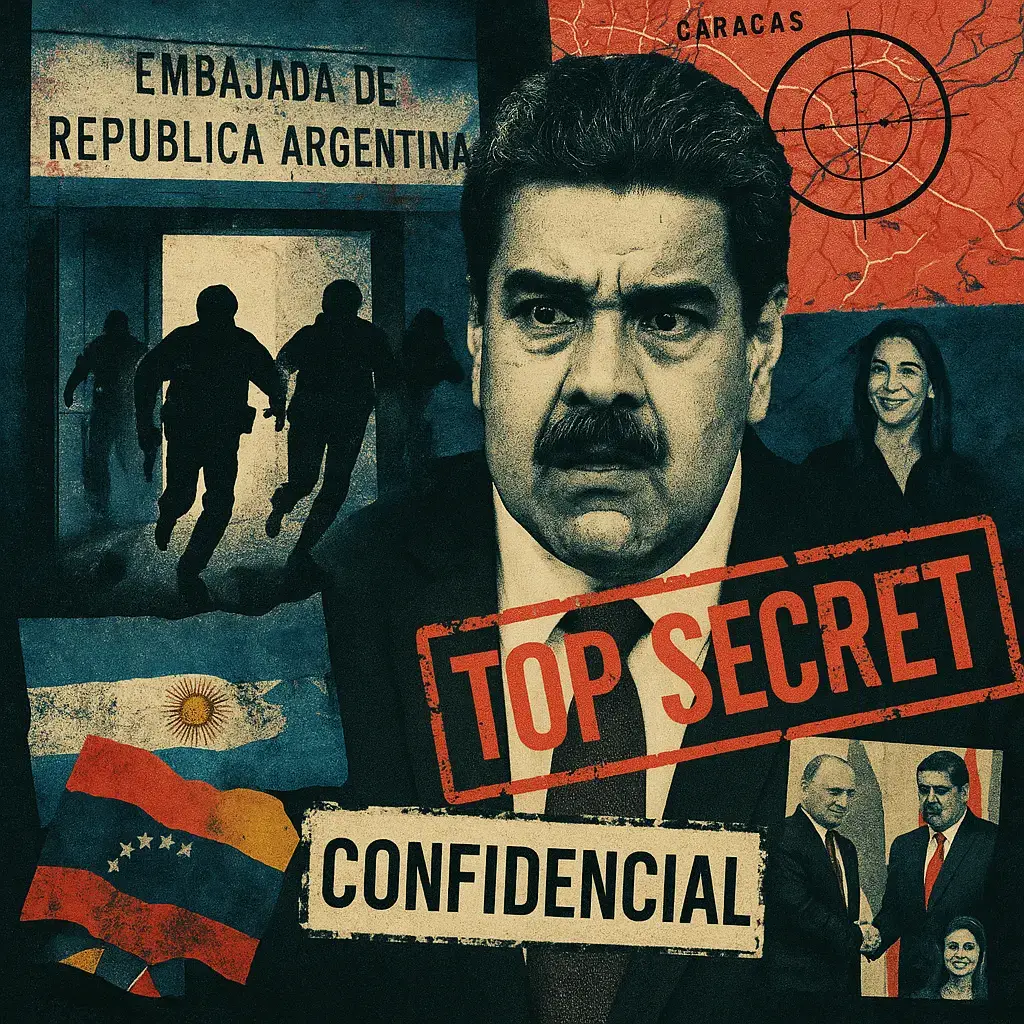
Caracas / Moscow / Washington / The Oval Office – If you thought spy thrillers had run out of ideas, hold on tight: Venezuelan reality has just scripted a pilot that would put Jason Bourne to shame. On May 6, 2025, while Nicolás Maduro was touring Moscow, taking selfies with Putin and signing papers with questionable expiry dates, a Hollywood-grade extraction was going down in his own backyard: “Operation Guacamaya.” The prize? Five opposition leaders who had spent more than 400 days playing hide-and-seek inside the Argentine Embassy in Caracas, plus, as a bonus, María Corina Machado's mother. A screamer into the top corner against the regime's narcissism.
The embassy as a VIP gulag: 412 days of chavista suffocation
Let's set the scene, because the run-up to this “special operation” (yes, we use the term with all the sarcasm in the world) is a textbook case of how a paranoid regime turns diplomacy into a survival reality show. Since March 2024, six members of the Vente Venezuela party (the people chavismo labels “terrorists” faster than you can order an arepa) had holed up in the Argentine Embassy looking for something resembling immunity. Big mistake. The compound, which since August 2024 had been looked after by Brazil like a problem child following the diplomatic tantrum between Milei and Maduro, turned into a luxury rat trap.
Picture it: 412 days without electricity (unless you had a generator and diesel, which Maduro made sure was hard to come by), no drinking water for a decent cup of coffee, and the SEBIN (the tropical Stasi) standing guard with drones buzzing like mosquitoes, signal jammers so you couldn't even send a tearful WhatsApp, and police cordons tighter than a tourniquet. All of it, of course, in flagrant disregard of that old relic called the Vienna Convention. Maduro's plan was simple: drown them in boredom and despair until they walked out with their hands up begging for mercy or, better still, use them as bargaining chips in some shady negotiation.
- 412
- days of siege at the embassy, with no electricity or drinking water
- 5
- opposition figures extracted in the operation
- March 2024
- when the six Vente Venezuela members took refuge in the compound
The master plan (or how to make the most of the cat being away)
And in the middle of it all, the cat went off to Moscow. The Victory Day parade, the event where Putin takes his war toys out for a walk, was the perfect distraction. According to the rumor mill, “Operation Guacamaya” was no last-minute improvisation. It took months of planning, with Trump's White House (presumably) pulling the strings, Argentina providing the house (and the scare), and Brazil looking the other way with all the discretion of a bull in a china shop. Technical support from the Italians and the Israelis, read: Mossad? Nobody will confirm it, but where there's smoke, James Bond is usually not far away.
On May 3, the pieces started to move. On the 5th, Corina Parisca Pérez, María Corina's 85-year-old mother, vanished from house arrest. Magic? No, friends, this smells like “a little help from the inside,” with a whiff of fresh bolívares or promises of a less chavista future. On the 6th came the big day: the five opposition leaders, like the cast of “The Great Escape,” were extracted from the embassy. The cars were a camouflage joke: they looked like official patrol vehicles. The plane was a masterpiece of disguise engineering: civilian on the outside, a covert military operation on the inside. They crossed half the country, probably praying that the only checkpoint they ran into would be busier hunting for an empanada than for “traitors to the homeland.”
- May 3 — The pieces start to move
The preliminary moves begin for an operation that, according to the rumor mill, had been months in the planning. - May 5 — Corina Parisca Pérez disappears
María Corina's 85-year-old mother vanishes from house arrest: the first sign of help from the inside. - May 6 — The extraction
With Maduro at the Moscow parade, the five opposition leaders leave the embassy in cars made to look like official patrol vehicles and board a civilian-looking plane.
Three days to empty an embassy that had been under siege for 412.
“It was negotiated,” says the regime
Miraflores' initial reaction: the awkward silence of someone caught red-handed. Then Diosdado Cabello, that master of the revolutionary euphemism, came out to claim it had all been a “negotiated exit.” A negotiation with no photos, no signed agreements and not a single joint statement is, quite simply, a story that doesn't hold up. The rest is smoke. And thick smoke at that.
Predictably, Marco Rubio stepped onto the stage to praise the allies and applaud what he called an “exemplary and precisely coordinated” operation. María Corina Machado, with the kind of smile that must give Miraflores hives, delivered the gem: “The regime didn't see it coming. Operation Guacamaya shows what is possible when there is will and strategy.”
Chavismo's fifth column: when the ship takes on water
But beyond the spectacle and the bargain-bin geopolitics, the really juicy part is the confirmation that chavismo is no longer the granite block we were sold. Getting five people out of a besieged embassy, in “official” cars and on a “civilian” plane, without setting off every alarm, is no accident. It is the acid test proving there are people on the inside, in uniform and holding a PSUV party card, who are already doing the math and looking for the emergency exits. Loyalty is in short supply when the captain seems more interested in dancing joropo with faraway dictators than in plugging the leaks.
An economy in flames: the perfect Molotov cocktail
And all of this while the Venezuelan economy rolls headlong toward the abyss. Trump, who seems to relish his role as global party-pooper, reinstated sanctions as if there were no tomorrow. Chevron, pack your bags. Repsol, no more licenses. And a 25% tariff on any drop of Venezuelan crude that dares to approach international waters. The result? The bolívar losing value faster than a corrupt politician's reputation (20% in April alone, no less), year-on-year inflation of 170% that turns today's bread into tomorrow's caviar, and oil output on the floor, not even reaching 600,000 barrels a day. Meanwhile China, the “friendly lender,” collects its debt in oil at fire-sale prices. A sweet deal... for China.
- 20%
- drop in the value of the bolívar in April alone
- 170%
- year-on-year inflation
- 25%
- tariff on every drop of Venezuelan crude in international waters
The economic backdrop to the operation.
Venezuela–Russia trade
| Category | Details |
|---|---|
| Total volume | Roughly US$200 million, up 64% on 2023 |
| Venezuelan exports | A 453% increase in non-oil exports to Russia between 2022 and 2024 |
| Main export categories | Food, beverages and tobacco, accounting for 89% of non-oil exports |
| Imports from Russia | Industrial equipment, machinery, pharmaceuticals, fertilizers, military technology and capital goods |
| Trade balance | Traditionally in deficit for Venezuela; current efforts aim to balance it by diversifying exports |
| Strategic agreements | A 10-year strategic partnership agreement signed in May 2025, covering sectors such as hydrocarbons, technology, defense and finance |
End of the show, or just a new act?
“Operation Guacamaya” is therefore much more than an episode of a Caribbean soap opera. It is a right hook to the jaw of a regime that believed itself untouchable on its own turf. It shows that absolute control is a myth, and that alliances, however odd they may look (Trump, Israel and chavista turncoats on the same team?), can bear unexpected fruit. And that maybe, just maybe, impunity has an expiry date.
Who helped from the inside? Are we looking at the prologue to Maduro's fall, or just one more episode of the tragic farce that is Venezuela? Will there be more “special operations,” or was this a warning shot to get Superbigote to sit down and negotiate for real, this time without a marked deck?
Today, the regime has not fallen. But the narrative of its omnipotence has been shattered. And in a country where hope is doled out drop by drop, that, dear friends, is almost a revolution. We will be watching closely, because this telenovela promises more twists than a spinning top in the hands of a hyperactive child. And here, in this digital corner where the truth hurts but entertains, we will tell you all about it, no holds barred.
Cybersecurity in the age of Guacamaya: what's cooking behind the scenes
Geopolitical events like this do not just reshape international alliances and stir up diplomatic tension: they also send a shockwave through the digital world. “Operation Guacamaya” already has a clear, concrete impact on regional and global cybersecurity:
- A surge in cyber espionage
- Regimes like Maduro's may step up surveillance of opposition figures, journalists and diplomats, using everything from malware to artificial intelligence techniques.
- Disinformation campaigns
- Expect a wave of fake news, social media bots and alternative narratives trying to rewrite what happened. Venezuela has built up experience in digital propaganda, and Russia is an expert at it.
- Tighter domestic surveillance
- After an operation like this, internal control mechanisms are likely to be reinforced, including more illegal interception, network traffic monitoring and the use of tools such as DPI.
- Opaque technology alliances
- The strategic agreement with Russia opens the door to greater exchange in defense technology, cyber intelligence and alternative financial systems (such as MIR), making tracking and traceability from the West harder.
- Regional response
- Neighboring countries and global players with interests in the region must be ready for retaliatory cyberattacks, sabotage campaigns or targeted data leaks driven by state-sponsored actors.
The operation's digital shockwave, as the article sees it.
Inside and outside the firewall. Operation Guacamaya was not played out only on land, in the air and through diplomacy. It also marks the start of a new phase on Latin America's cyber chessboard. And there, as always, we need to look very closely at what happens outside... and inside the firewall...
Related service
Offensive cybersecurity services
Topics
#Hybrid-threats #Humanitarian-crisis #Espionage #Geopolitics #Special-operations #Operation-Guacamaya