The Drone King – Operation Spiderweb: a masterstroke of intelligence and technology
By Kike Gandia · Drones & Defense · 6 min read
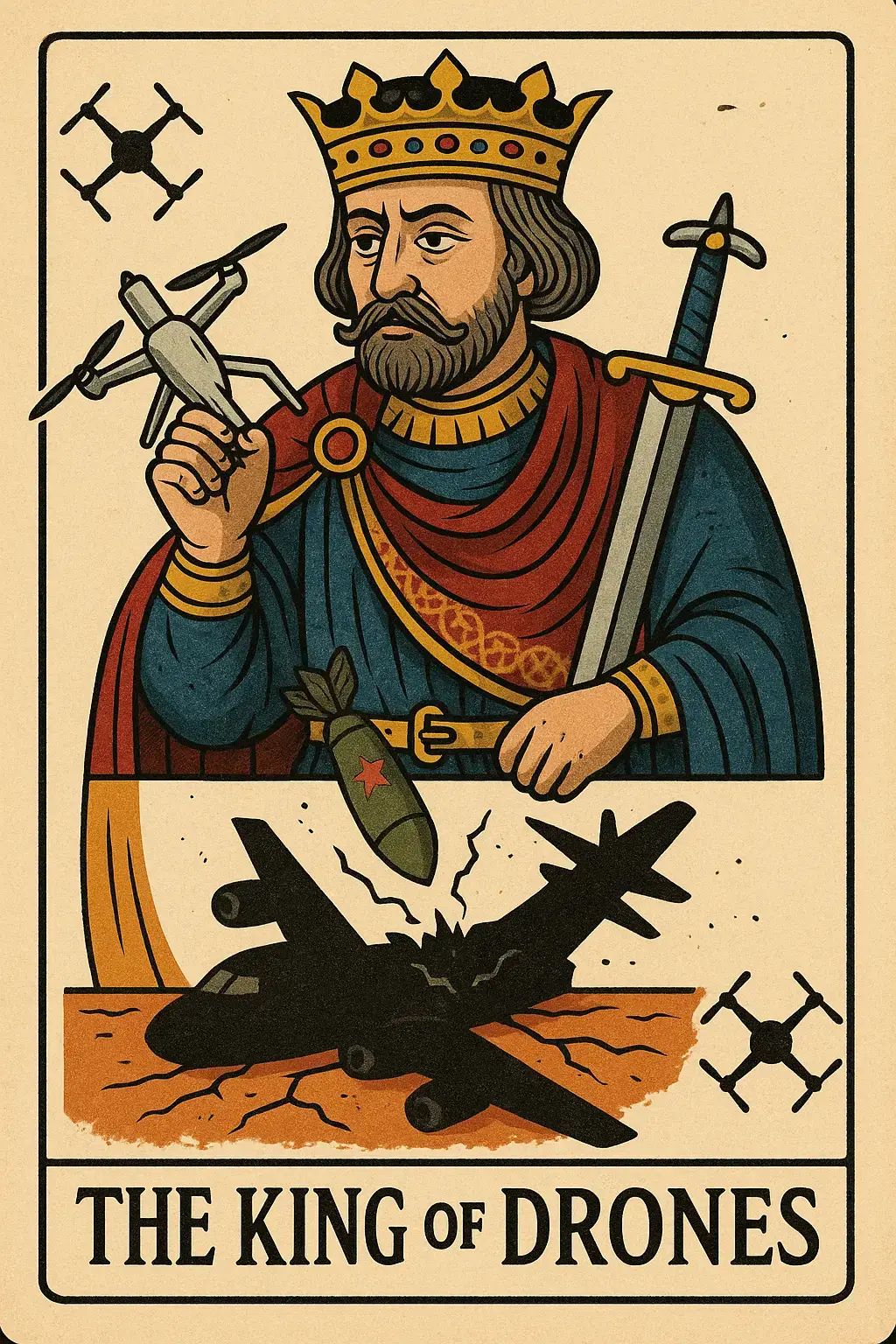
June 1, 2025 was no ordinary day in the war between Russia and Ukraine. It was a turning point. A technological punch straight to the heart of the Kremlin. A metallic buzz that crossed thousands of kilometers and turned into fire, rubble and silence. A surgical operation, ruthless and brilliant at the same time, that left 41 Russian bombers reduced to smoke, dust and glowing scraps of titanium.
But it wasn't F-16s. It wasn't Tomahawk missiles. It wasn't even strike systems on loan from NATO. No. It was small drones, most of them built from parts you can buy in any online store, guided not by human hands but by the cold logic of an artificial intelligence trained to kill. The largest uncrewed air attack in history. A new chapter in modern warfare. And Ukraine wrote it.
The operation, codenamed Operation Spiderweb, needed no more than €120,000 in equipment. Yes, you read that right. A hundred and twenty thousand euros to obliterate a fleet whose total value is estimated at five to seven billion dollars. If someone had told you a year ago that an army could cripple a nuclear superpower with €200 drones running computer vision, you would have thought they were mad. And yet here we are.
A deadly dance choreographed in the utmost secrecy over 18 months. A plan hatched by the SBU, Ukraine's security service, to take revenge for years of relentless bombing of its cities. And it worked.
The scale of Operation Spiderweb is hard to overstate. In a single day, Ukraine destroyed between 30% and 44% of Russia's bomber fleet, a force estimated at 90 to 130 aircraft. Among the targets were the prized Tupolev bombers and Beriev A-50 early-warning aircraft, essential to Russian air control. Economic losses are put at around $7 billion, a devastating blow for a country already worn down by sanctions and a drawn-out conflict.
- 41
- Russian bombers destroyed in a single day
- 30–44%
- of Russia's bomber fleet
- €120,000
- in equipment for the entire operation
- $7B
- in estimated losses for Russia
The asymmetry of Operation Spiderweb, in four figures.
To grasp the scale of this attack, you have to look at the map. It's not just that Ukraine struck Russian territory, which had happened before. This time it reached further than anyone had imagined. All the way to bases like Belaya, in eastern Siberia, closer to Japan than to Kyiv. Or to Olenya, in Murmansk, a base shared with strategic submarines, deep in the Arctic. Some of the targets were more than 4,000 kilometers away. That is like crossing half of Russia undetected, without leaving a trace, and hitting the very center of gravity of Russia's strategic aviation. Tupolev bombers, Beriev A-50 early-warning aircraft, entire hangars reduced to scrap. A fleet decimated. A whole country left speechless.
And the most astonishing part: no Western support needed, no escalation, no foreign technology. All of it done with drones built on Ukrainian soil. Many of them FPV drones — the kind used for racing or surveillance — converted into small kamikazes with explosive warheads, flying at 120 km/h and programmed for a range of up to 10 km. So how did they get that far? That is where the genius lies. They didn't fly from Ukraine. They launched from inside Russia.
- 117
- drones, each assigned a specific target
- 4,000 km
- to some of the targets, as far as Siberia and the Arctic
- 120 km/h
- top speed of FPV drones converted into kamikazes
- 10 km
- programmed range per drone
Civilian trucks, ordinary-looking and loaded with harmless goods, drove deep into Russia as if they were routine logistics runs. But what they carried were hives of death. Swarms of drones packed into hidden compartments, programmed to activate at a set time, with predefined routes, targets identified by prior intelligence and an autonomous navigation system trained for more than a year on satellite reconnaissance data. No remote pilots. No vulnerable links. Just pure, hard AI.
Artificial intelligence was at the heart of this operation. Each of the 117 drones had a specific target and was programmed to identify and strike vulnerable points on the Russian aircraft. This technology let Ukraine overcome the logistical limits of operating in enemy territory, removing the need for human pilots who would easily have been detected. The drones also had self-destruct systems, ensuring Russia could not reverse-engineer the technology to replicate it. Each one knew exactly where to go, which aircraft to hit and where on the fuselage to strike. And on top of that, they could tell real aircraft from decoys, legitimate targets from traps painted on the ground.
- 18 months — Secret preparation
The SBU hatches the plan over a year and a half and trains the autonomous navigation system on satellite reconnaissance data. - Infiltration — Civilian trucks inside Russia
Ordinary-looking vehicles cross the border carrying swarms of drones packed into hidden compartments: the launchers are already inside the country. - Activation — No pilot, no link
At a set time, 117 drones take off with predefined routes and targets already identified. No remote pilots, no vulnerable links to jam. - Erasure — Self-destruction
The drones self-destruct and the launch points are wiped out: no hardware is left for Russia to study or copy.
Why the operation can't be copied by examining the wreckage: the mechanics, step by step.
The strikes came without warning. No alarms. No interceptors. Just explosions. In the blink of an eye, more than 40% of Russia's bombers were put out of action. For a country that bases much of its deterrence strategy on these aircraft, the blow was not just logistical. It was symbolic. Brutal. Irreversible.
Beyond the material damage, the attack has far-reaching implications. The destroyed bombers were Russia's main tool for striking Ukrainian cities, wreaking havoc in places like Kyiv, Kharkiv and Dnipro. By significantly reducing that capability, Ukraine not only protects its civilians but also forces Russia to redeploy its counter-drone defenses, weakening its position on the front line.
And in case you are wondering: why haven't they copied them yet? Because they can't. Because after the attack, every launcher was destroyed. The trucks blew up. The launch points were wiped out by the drones' own software. There are no launch devices to study. No samples to analyze. Just charred remains. Just shadows.
The psychological impact is just as significant. The operation exposed Russia's vulnerability, even in regions as remote as Siberia or the Arctic. Russian propaganda, which quickly turned to nuclear threats, reflects the disarray in the Kremlin. Yet with a depleted bomber fleet and the possibility that Ukraine will repeat similar attacks, Putin faces a dilemma: strengthen home defenses at the expense of the front, or risk further humiliation.
Operation Spiderweb comes at a crucial moment. With peace talks scheduled for June 2 in Istanbul, Ukraine has strengthened its negotiating position. Russia, which in the past demanded surrender, now faces a Ukraine that not only holds out but rewrites the rules of the game. The possibility that Ukraine will keep using similar tactics raises questions about the future: could Russia lose the ability to bomb Ukrainian cities? Could Ukraine reopen its airspace and its airports?
This was no ordinary military operation. It was an act of revenge. A warning. And a dress rehearsal. Because if one thing became clear that night, it is that Ukraine can do it again. Because the model does not depend on large factories or complex infrastructure. It depends on data, AI, ingenuity and infiltration. And those are weapons Ukraine has shown it has mastered.
This attack is not just a military victory but a symbol of resilience and ingenuity. Ukraine has shown that with limited resources but a brilliant strategy, it can take on a superpower. Operation Spiderweb is not just a chapter in this war; it is a lesson to the world on how determination and technology can change the course of history.
Will we see more attacks on this scale? Only time will tell, but one thing is certain:
Ukraine has spun a web that Russia will not easily escape.
Related service
Adversary simulation and red teaming
Topics
#Drone #Drones #Asymmetric-Warfare #Artificial-Intelligence #Threat-Intelligence #Ukraine
Keep reading
- Drone security: critical threats and how to protect airspace in 2025
- Drones and AI: how they are changing the balance of modern warfare
- Hacking Drones III: Drone Warfare – Active Defense and Operational Resilience
- Elite hunters: threat hunting as a strategic advantage
- Military jet falls into the Red Sea