Drones and AI: how they are changing the balance of modern warfare
By Kike Gandia · Drones & Defense · 6 min read
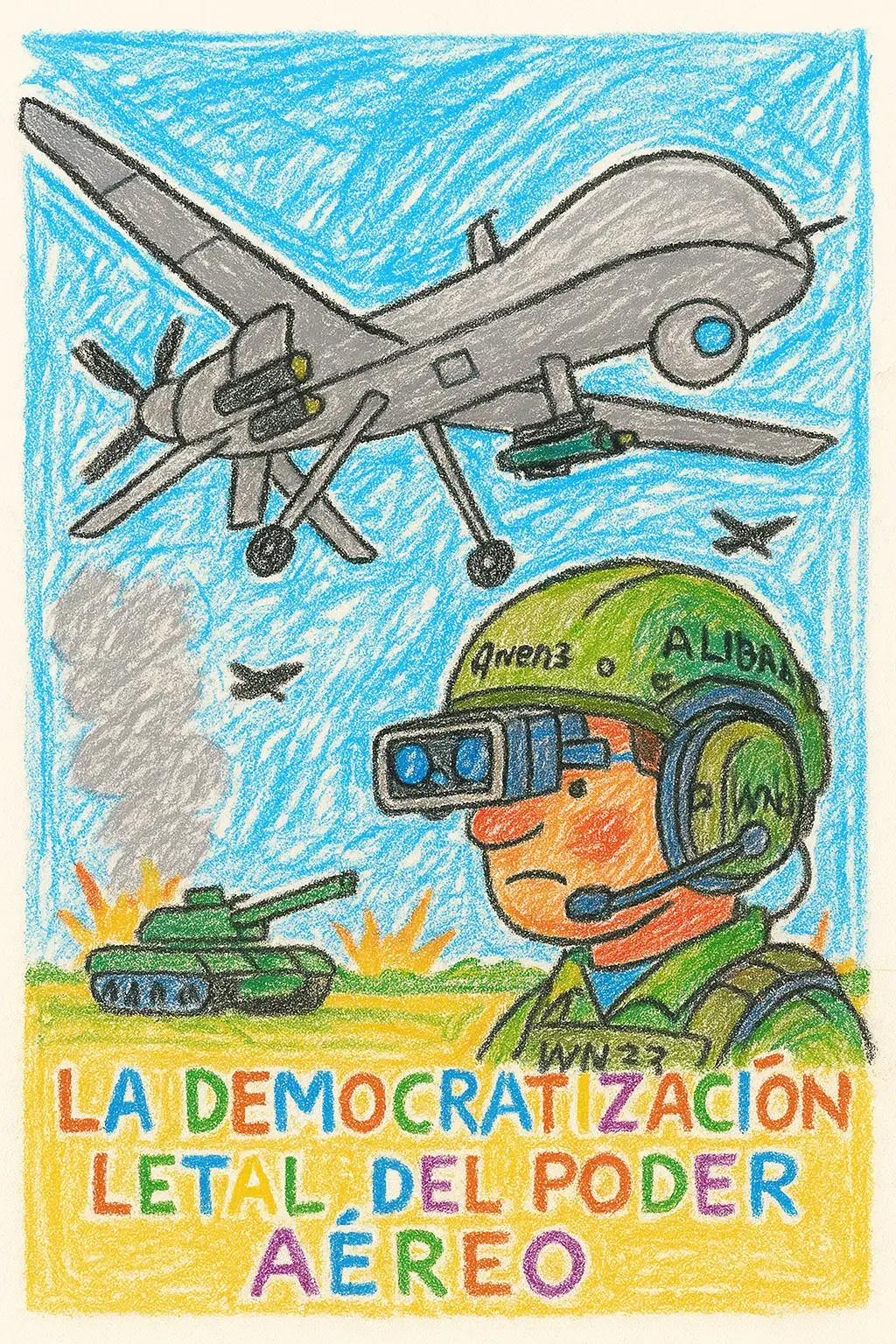
The convergence of unmanned aerial systems and artificial intelligence models is redefining modern warfare and, with it, the attack surfaces that cybersecurity has to defend. What used to be science fiction is now operational reality: AI-coordinated drones that make tactical decisions in milliseconds, datalink vulnerabilities that let an attacker hijack entire fleets, and non-state actors with capabilities that once belonged only to the great powers.
The lethal democratization of air power
The war in Ukraine has exposed an uncomfortable truth for traditional military strategists: a modified commercial drone that costs $500 can take out a tank worth several million. That economic equation fundamentally inverts the risk-reward calculation that has dominated military operations for decades.
FPV (first-person view) drones carrying improvised explosive payloads have become the tactical weapon of choice. Their low cost allows mass deployments in which losing individual units simply doesn't matter. More worrying still, the technology needed to build them is freely available on the civilian market.
From a cybersecurity perspective, every drone in the air represents several threat vectors at once. It is a vulnerable network node whose RF communications can be intercepted; an exfiltration vector equipped with optical sensors capable of capturing sensitive information; a physical attack platform that can carry anything from explosives to EMP devices; and a pivot point for breaching security perimeters that were designed with ground-based threats in mind.
Artificial intelligence in the decision cycle
This is where things get really interesting. Multimodal language models such as Alibaba's Qwen3, OpenAI's GPT-4 or Anthropic's Claude are not just sophisticated chatbots. Integrated into military architectures, they can perform real-time multi-sensor intelligence fusion, coordinate swarms of dozens or hundreds of drones, and adapt electronic warfare strategies through continuous learning.
The emerging operational architecture is not "human versus AI" but a layered hierarchy: human commanders set objectives and rules of engagement, AI systems plan and allocate resources at the operational level, and autonomous swarms execute and react at the tactical level. This structure compresses the OODA loop (Observe-Orient-Decide-Act) from minutes to seconds, but it introduces entirely new failure modes.
An AI-coordinated drone swarm can reassign targets dynamically, reconfigure its formation when nodes are lost, and carry out collective evasive maneuvers. More importantly, it can operate fully autonomously for extended periods, immune to communications jamming because it does not need a constant link to a human operator.
The threat vectors nobody is talking about
- Supply chain Components nobody designed to be secure
- Most components in civilian and military drones come from global supply chains that were never designed with operational security in mind. Chips, sensors, batteries and GPS modules are made by companies that put cost ahead of security. That creates massive opportunities for compromise at the source.
- Firmware Backdoors and hardware implants
- Picture backdoors in flight-controller firmware that allow remote activation, hardware implants in GPS modules that report positions to third parties, or compromised OTA updates that turn entire fleets into hostile assets. This isn't paranoia: it's reverse engineering applied at industrial scale.
- Model Adversarial attacks on the coordinating AI
- The AI models that coordinate these systems are vulnerable too. Adversarial attacks are not theoretical: you can poison training datasets by inserting malicious examples that bias target classification, create visual patterns that confuse detection algorithms (physical adversarial camouflage), or extract the model through systematic queries to replicate its tactical behavior.
- Datalink Protocols unencrypted by default
- Protocols such as MAVLink run unencrypted by default. DJI's Lightbridge uses proprietary encryption that has been broken several times. Analog FPV links on 900 MHz, 2.4 GHz and 5.8 GHz are trivially interceptable. An attacker with $300 worth of SDR (software-defined radio) gear can carry out selective jamming, GPS spoofing to divert a flight path, video-feed hijacking, or command injection on unauthenticated datalinks.
The four threat vectors this article puts on the table.
A real-world scenario: attacking critical infrastructure
Let's take a concrete case. A Tier III data center with N+1 redundancy, backup generators and traditional perimeter physical security. The adversary is a state actor or an APT group with moderate resources: a budget of $100K–$500K and strong technical capability.
- Weeks before — Persistent reconnaissance
The attack starts with sub-250-gram micro-drones fitted with 4K and infrared cameras. Over several weeks, these drones map the site using photogrammetry, identify staff patterns, log shift-change times and locate weak points in the perimeter. All of this happens at an altitude of 100 meters, practically invisible and beyond the reach of most physical security systems. - 03:00 — The swarm goes in with no external link
The attack phase uses a swarm of 30–50 FPV drones coordinated by an AI model running locally on an edge server. There is no dependency on external communications: the swarm operates fully autonomously. The attack is launched at 3 a.m. to minimize visual detection. - Targets — Cooling and generators
The primary targets are the cooling systems and backup generators. Short-range EMP and incendiary payloads destroy critical equipment within minutes. The attack is designed to saturate the defenses: even if anti-drone systems neutralize 60–70% of the swarm, the surviving nodes complete the mission. - Outcome — Downtime, physical compromise and exfiltration
The result: prolonged downtime, possible physical compromise of servers, and data exfiltration through high-resolution optical sensors during the reconnaissance phase. Total cost of the attack to the adversary: under $100K. Cost to the target organization: millions in direct losses, plus incalculable reputational damage.
The attack on the Tier III data center, phase by phase.
- $500
- the cost of a modified commercial drone that can take out a multimillion-dollar tank
- $300
- the SDR gear needed for jamming, GPS spoofing or command injection
- 30-50
- AI-coordinated FPV drones in the scenario described
- <$100K
- total cost of the attack to the adversary, versus millions in losses
The economic asymmetry that inverts the risk-reward calculation behind all classic defense.
Defense in depth: beyond jamming
An effective response requires a multi-layered defense architecture. Early detection relies on synthetic aperture radars calibrated for micro-UAS, acoustic sensors with ML classification, RF scanning across typical drone frequencies, and optical systems with multispectral tracking.
Identification and classification use machine learning to analyze acoustic and RF signatures, correlate flight patterns with databases of known threats, and tell legitimate air traffic from hostile traffic.
For neutralization: directional jamming of GPS and control links, high-energy anti-drone laser systems, kinetic interceptors such as net guns or hunter drones, and high-power microwaves to disable electronics at a distance.
But defending your own infrastructure requires fundamental hardening: end-to-end AES-256 encryption for all telemetry, mutual TLS authentication for command and control, automatic key rotation, secure boot on flight controllers, digitally signed firmware, runtime attestation, a zero-trust architecture with network segmentation, multi-factor authentication, and exhaustive logging backed by a blockchain for an immutable audit trail.
Redundancy is critical: backup inertial navigation independent of GPS, multi-channel communications with automatic failover, and a Return-to-Home mode on signal loss that does not depend on external links.
The future is already here
We are not talking about future technology. Everything described in this article can be built today with commercial components and open-source software. The AI models required are available under permissive licenses. The drones can be bought from online stores. The technical know-how is documented in public forums and GitHub repositories.
The barrier to entry for hostile actors has never been lower. A five-person team with intermediate skills in robotics, networking and machine learning can put together offensive capabilities that used to require military budgets. That is the reality organizations responsible for critical security have to face.
It's no longer "could it happen?". The question is no longer "could it happen?" but "when will it happen?". Organizations that are not actively investing in anti-drone countermeasures and in hardening their critical systems are operating with catastrophic residual risk.
About QuantumSec: We specialize in critical infrastructure security, emerging threat analysis and next-generation defensive architectures. If your organization needs a vulnerability assessment against drone threats or help implementing countermeasures, get in touch with our tactical response team.
Related service
Adversary simulation and red teaming