MCP and A2A: How the protocols orchestrating the new intelligence between models and agents work
By Kike Gandia · AI & Security · 4 min read
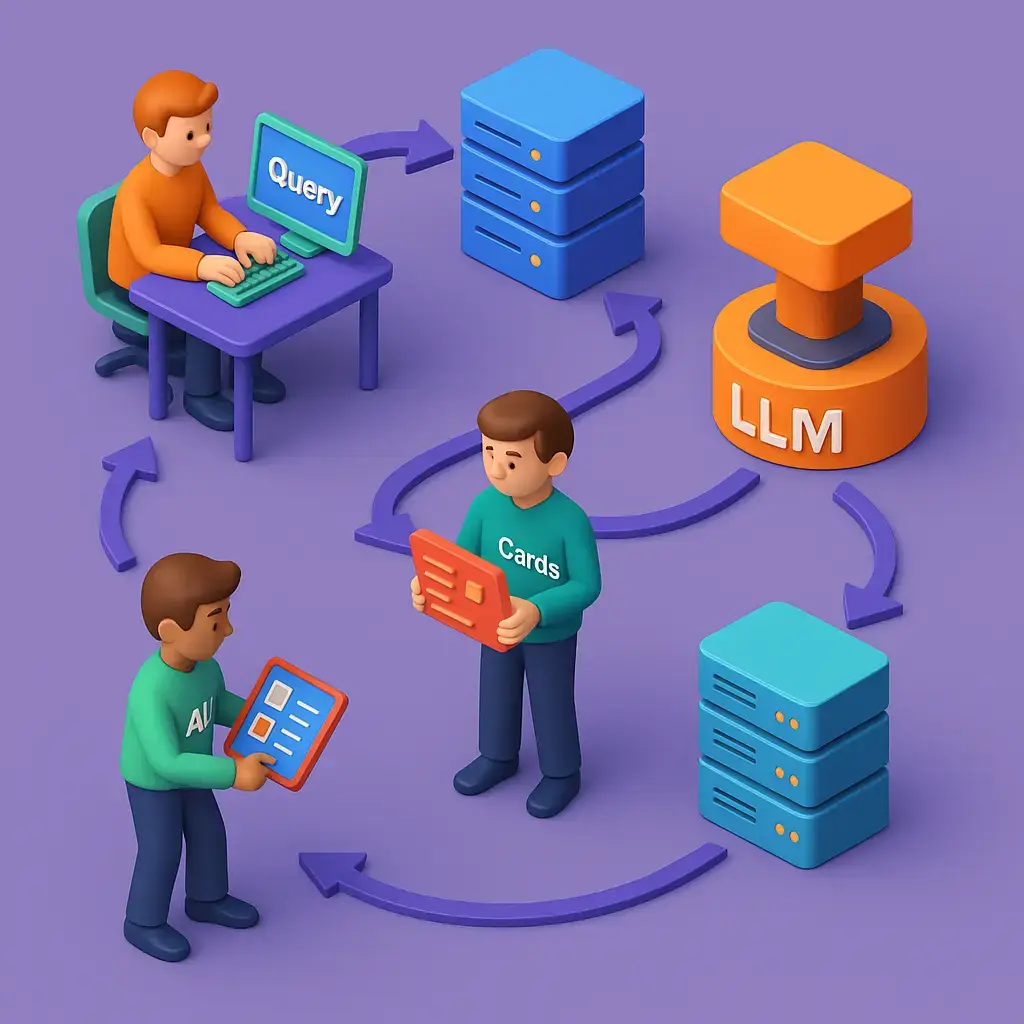
The post-API era is no longer a promise: it is the new standard. The world's most advanced AI platforms are leaving monolithic architectures behind and moving to distributed systems that communicate, collaborate and reason autonomously. At the heart of this shift are two decisive protocols: MCP (Model Context Protocol) and A2A (Agent to Agent Protocol).
Both do more than make models more efficient: they create an intelligent coordination layer that lets multiple models, agents and environments understand one another, cooperate and act within a framework of governance, security and context. This is not just a technical evolution. It is a new way of putting intelligence to work.
MCP · Model Context Protocol coordinates models
- Assesses the context, the intent and the nature of the problem before choosing a model and a server.
- Queries internal dashboards and external sources before invoking the LLM.
- Handles human validation when it is needed.
- The output is not text: it is an informed, auditable action executed on the right platform.
A2A · Agent to Agent Protocol connects agents
- Agents built on different frameworks discover and evaluate one another.
- They cooperate in real time, without direct human intervention.
- It decentralizes decision-making.
- Unlike an API, here the agents decide how to collaborate, how to split the task and when to escalate.
The two protocols behind the coordination layer: one chooses what to respond with, the other divides up the work.
MCP: contextual intelligence that knows when, how and with whom to act
MCP turns any user query into a strategic operation. Instead of sending the same question to a generic model, the system assesses the context, the intent and the nature of the problem, and only then selects the best combination of model and server to answer it.
Say you ask for a risk analysis of an energy investment in South America. MCP doesn't just look for the model with the most financial knowledge. First it queries internal dashboards, adds information from external sources such as Slack or previous reports, and only then invokes the most suitable LLM, which might be a private financial model hosted on a specialized server. If validation by a human analyst is required, it handles that. If the resulting action involves creating alerts or sending reports, it does that too.
The final answer is not just a block of text. It is an informed, auditable action executed on the right platform.
- Step 1 — The query arrives
For example, a risk analysis of an energy investment in South America. - Step 2 — Context is gathered
MCP queries internal dashboards and adds information from external sources such as Slack or previous reports. - Step 3 — The model is chosen
Only then does it invoke the most suitable LLM, which might be a private financial model hosted on a specialized server. - Step 4 — The action is executed
If it requires validation by a human analyst, MCP handles it. If it involves creating alerts or sending reports, it handles that too.
The difference from sending the question to a generic model: every step decides something before the answer is given.
A2A: autonomous agents that cooperate like a human team
Where MCP coordinates models, A2A connects intelligent agents to one another. The A2A protocol lets autonomous agents built on different frameworks discover each other, evaluate each other and cooperate in real time. This decentralizes decision-making and enables autonomous workflows without direct human intervention.
One agent might monitor international media, pick up signs of geopolitical risk and, if something stands out, contact another agent that specializes in financial analysis to estimate the impact. A2A makes this collaboration seamless and traceable. How is that different from a plain API? Here the agents decide how to collaborate, how to split the task and when to escalate.
QuantumLabs: where this technology becomes a competitive advantage
At QuantumSec we don't just study these architectures: we integrate them into real businesses. We do it through QuantumLabs, our advanced innovation lab, where we develop, train and deploy production-ready autonomous agents, MCP workflows and A2A networks.
At QuantumLabs, we are already applying MCP and A2A to:
- Audit Intelligent internal auditing
- Agents that review changes to critical systems, detect anomalies or compliance deviations and trigger MCP workflows that automatically escalate findings to the legal, technical or executive teams.
- Monitoring Reputation monitoring and threat intelligence
- One agent analyzes forums, Telegram, the dark web and social media; another classifies threats through semantic analysis; and a third generates alerts with real exposure context for each department.
- HR Autonomous employee onboarding
- An agent analyzes the new hire's profile and uses MCP to coordinate their training on internal systems, security policies, compliance and tools according to role and department.
- Legal Large-scale document analysis
- They ingest thousands of pages of contracts, audits or regulations, break them down with agents specialized in legal structure and produce summaries, executive reports or recommendations for the board.
- Fraud Detection in payments and crypto transactions
- Workflows that connect financial agents, prediction models and wallet behavior analysis to flag unusual transactions and automate responses in real time.
What QuantumLabs is already doing with MCP and A2A in real businesses.
Make your systems collaborate. Automate what's critical. Protect what's essential.
QuantumLabs turns these architectures into working solutions for your business. If you operate in sectors such as finance, defense, legal, healthcare, energy, insurance or critical industry, we can help you deploy distributed autonomous intelligence that adapts to your needs, your infrastructure and your security standards.
From design to integration, including training and regulatory compliance, QuantumSec is building the invisible layer that will let your systems think, decide and collaborate like an expert team. Because the AI of the future isn't just more powerful. It is more connected, more strategic and more human in the way it operates.
And it's no longer science fiction. It's already happening. Will you watch it go by, or will you lead it?
Related service
AI and LLM penetration testing