Kimi K2.5 in depth
By Kike Gandia · AI & Security · 20 min read
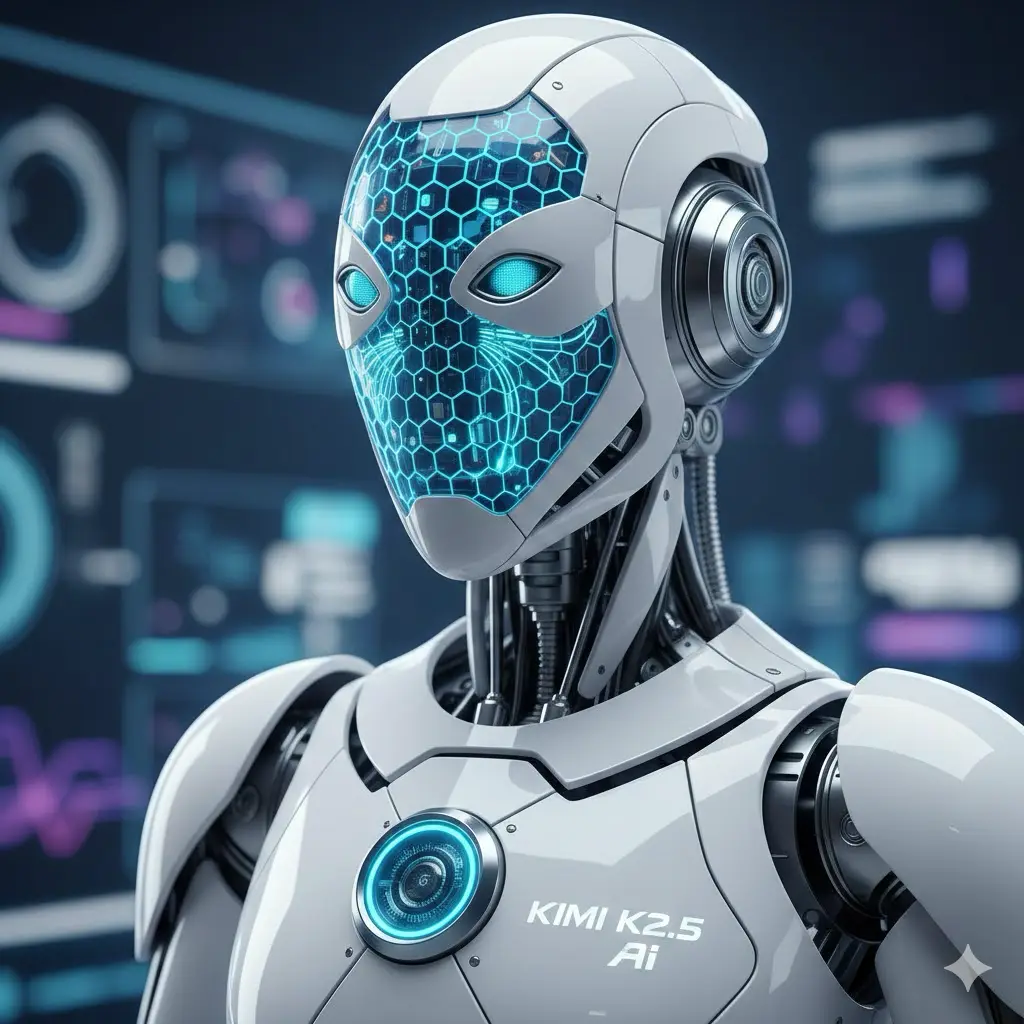
Kimi AI is the family of large language models (LLMs) developed by Moonshot AI, a Chinese startup founded in 2023 with a single stated goal: building artificial general intelligence. In less than three years, Kimi has gone from being a pioneering long-context chatbot to releasing trillion-parameter models that compete head-on with the most advanced systems in the world, such as GPT-5, Gemini and Claude, at a fraction of their cost.
This report takes an in-depth look at the technology, evolution, competitive positioning and strategic implications of Kimi AI for companies, developers and cybersecurity professionals in Europe.
Key fact. Moonshot AI generates $240 million in annual revenue with only ~80 employees and a $4 billion valuation. Its open-weight model Kimi K2 outperforms GPT-5.2 Pro on autonomous research benchmarks and is released under a modified MIT license.
- 1T
- total parameters (K2.5)
- ~80
- employees at Moonshot AI
- $240M
- annual revenue (2025)
- $4B
- company valuation
Moonshot AI: the company behind Kimi
Origins and vision
Moonshot AI was founded in March 2023 in Beijing by Yang Zhilin, Zhou Xinyu and Wu Yuxin. The company's name is a tribute to Pink Floyd's album The Dark Side of the Moon — Yang Zhilin's favorite album — and its launch coincided precisely with the record's 50th anniversary.
Yang makes no secret of the founding ambition: to build models that can reach AGI. To get there, he has set out three technical milestones that guide every product and architecture decision: mastering long context, creating a genuinely multimodal world model, and designing a scalable architecture capable of continuous self-improvement without human intervention.
The business model: efficiency as a competitive edge
Moonshot AI has shown that algorithmic excellence can compete with the power of massive capital. While its rivals operate with thousands of employees and data centers worth tens of billions of dollars, Moonshot has built frontier-level models with a headcount that would fit on a bus.
This extraordinary ratio rests on three strategic pillars. The first is optimizer innovation: the development of the Muon optimizer, which halves the computational cost of training compared with the standard AdamW, is a real, quantifiable technical advantage. The second is open source as a distribution lever: releasing models under a modified MIT license lets researchers and startups adopt Kimi at scale, building community and visibility with no marketing spend. Large companies that exceed certain revenue or user thresholds are required to display the Kimi brand, turning its most successful customers into involuntary advertising. The third is aggressive API pricing: at $0.15 per million input tokens, Kimi K2 costs between ten and twenty times less than its main comparable competitors, which encourages mass adoption.
Funding and growth
In February 2024, Alibaba Group led a $1 billion funding round that raised Moonshot AI's valuation to $2.5 billion. By the end of 2025, the company had reached a $4 billion valuation and 36 million monthly active users on its consumer chatbot. On the enterprise side, the API platform has won share in legal, financial and research segments that live inside documents — precisely where Kimi's long context delivers the greatest operational advantage.
Timeline: the evolution of Kimi AI
Kimi's trajectory over less than three years is a story of bold technical bets that paid off. Each iteration has not simply been an incremental improvement, but an architectural leap that has reset market expectations.
| Date | Milestone | Technical significance |
|---|---|---|
| Oct 2023 | Kimi chatbot launch (128K tokens) | The world's first consumer model with that level of context |
| Mar 2024 | Context expanded to 2M characters | System crashed under massive demand; an unprecedented milestone |
| Jul 2024 | Context Caching in public beta | Lower costs for long-document workflows |
| Jan 2025 | Kimi K1.5 — claimed parity with OpenAI o1 | Combines RL with long-context memory; multimodal reasoning |
| Apr 2025 | Kimi-VL (16B MoE, 3B active, open-source) | Moonshot's first open-weight vision model |
| Jun 2025 | Kimi-Dev (72B) + Kimi-Researcher | State of the art on SWE-bench among open-source models; autonomous agent |
| Jul 2025 | Kimi K2 (1T params, modified MIT, open-weight) | Frontier benchmarks; open-source under a modified MIT license |
| Sep 2025 | OK Computer — multimodal agentic AI | Websites, slides, analysis of 1M rows, text + audio + image + video |
| Oct 2025 | Kimi Linear (48B MoE, KDA attention) | New attention architecture, more efficient on long contexts |
| Jan 2026 | Kimi K2.5 (1T MoE, natively multimodal) | Agent Swarm: up to 100 parallel sub-agents; outperforms GPT-5.2 Pro |
Technical architecture: what's under the hood
Mixture of Experts (MoE): efficiency at trillion scale
Both Kimi K2 and K2.5 use a Mixture of Experts architecture with 1 trillion total parameters and 32 billion parameters active during inference. In practice, this means the model has the capacity of a trillion-parameter system but the computational cost of a 32-billion-parameter one: only a fraction of the experts are activated for each token processed.
This architecture is not unique to Moonshot, but what sets Kimi apart is the scale at which it has been executed with zero instability incidents during training. Training a 1T-parameter MoE model on 15.5 trillion tokens while keeping the process stable is a technical achievement that very few organizations in the world have pulled off.
MuonClip: the optimizer that changed the rules
Moonshot's efficiency leap does not come from the architecture alone, but from its custom optimizer. Kimi K2 was trained with the Muon optimizer, scaled to an unprecedented size in collaboration with the University of California, Los Angeles (UCLA). The results of the joint paper show that Muon improves computational efficiency by a factor of 2 compared with AdamW, the industry standard, for large-scale models.
To handle the instabilities that appear when scaling Muon to 1T-parameter models, the team developed MuonClip: a set of stabilization techniques that keep the training process under control without sacrificing speed. The optimizer code and the pre-training checkpoints have been released openly.
Kimi Delta Attention (KDA): attention for extreme contexts
Introduced in Kimi Linear in October 2025, Kimi Delta Attention is an in-house attention mechanism that reduces memory usage and improves generation speed in long context windows. As models process sequences of hundreds of thousands of tokens, standard attention mechanisms become prohibitively expensive. KDA tackles this bottleneck more efficiently than existing alternatives, allowing context to scale sustainably.
MoonViT-3D: native vision, not a bolt-on
One of the most significant architectural decisions in Kimi K2.5 is integrating the MoonViT-3D vision encoder natively, instead of attaching a vision module to an already trained language model. This means K2.5's 15 trillion training tokens are a genuine mix of text and images, creating unified representations rather than translations between two separate systems.
The practical result is that K2.5 has genuinely integrated visual understanding, which is especially relevant for frontend development, interface analysis, chart interpretation and workflows that combine visual documents with textual reasoning.
Kimi K2.5: the state of the art in February 2026
Released in January 2026, Kimi K2.5 is the biggest qualitative leap in Moonshot AI's history. It is not simply an update to K2, but the convergence of three lines of research the team had been pursuing in parallel: native vision, scaled agentic execution and productivity in knowledge-intensive environments.
The four operating modes
K2.5 offers four distinct interaction paradigms, each optimized for a different type of task:
| Mode | Description | Main use cases |
|---|---|---|
| Instant | Fast, direct answers without an extended reasoning process | Queries, searches, factual answers, conversation |
| Thinking | Step-by-step reasoning with visible internal reflection | Math, complex logic, technical analysis, debugging |
| Agent | Autonomous execution of workflows with external tools | Generating reports, spreadsheets, presentations, PDFs |
| Agent Swarm | Orchestration of up to 100 sub-agents in parallel (preview) | Deep research, multi-source analysis, massive tasks |
Agent Swarm: the paradigm shift
Agent Swarm is without doubt the most disruptive feature of K2.5 and probably one of the most important in the recent history of LLMs. While traditional agentic systems operate sequentially — one agent executes steps one after another — K2.5 can break a complex task down into subtasks and orchestrate their simultaneous execution across up to 100 independent agents.
To train this capability, Moonshot developed PARL (Parallel Agent Reinforcement Learning), a reinforcement learning technique designed specifically for multi-agent systems. PARL solves three technical challenges that had stalled progress in this area: training instability when multiple agents interact, ambiguous credit assignment (determining which agent contributed to which result), and serial collapse, the tendency of the orchestrator to simply chain agents in series instead of parallelizing them intelligently.
The benchmark results are compelling. On BrowseComp, which measures the ability to research and retrieve complex information on the web, K2.5 outperforms GPT-5.2 Pro. On WideSearch, which evaluates search breadth and depth, it outperforms Claude Opus 4.5. Execution times drop significantly thanks to the parallelization of subtasks that previously had to run in sequence.
Strategic perspective. The ability to orchestrate 100 parallel agents across up to 1,500 coordinated steps is not an incremental improvement on existing agentic systems — it is an order-of-magnitude shift. Tasks that required hours of manual work or days of sequential execution can be completed in minutes.
Performance and benchmarks: the numbers that matter
Objectively evaluating the performance of AI models is complex and often controversial, but standardized benchmarks provide useful reference points for comparison. Kimi K2 and K2.5 have been evaluated extensively on the industry's most demanding tests.
Kimi K2 performance on key benchmarks
| Benchmark | Kimi K2 | Description |
|---|---|---|
| SWE-bench Verified | 71.6% (parallel) | Autonomous resolution of real issues in GitHub repositories |
| SWE-bench Multilingual | 47.3% pass@1 | International version of the software engineering benchmark |
| AIME / HMMT / CNMO | State of the art* | Elite math competitions (avg@k for stability) |
| GPQA-Diamond | Frontier-level score* | PhD-level science questions (physics, chemistry, biology) |
| EvalPlus | Frontier-level performance* | Evaluation of correct, robust code generation |
* Exact data points are not published because of evaluation costs, but Moonshot reports performance on par with the best non-thinking models available.
Competitive comparison: Kimi vs. the big players
| Feature | Kimi K2.5 | GPT-5 | Claude Opus 4.5 | Gemini 2.0 |
|---|---|---|---|---|
| Architecture | 1T MoE / 32B active | Not disclosed | Not disclosed | Not disclosed |
| Open-weight | ✓ Modified MIT | ✗ Closed | ✗ Closed | ✗ Closed |
| Native Agent Swarm | ✓ Up to 100 agents | ✗ | ✗ | ✗ |
| Natively multimodal | ✓ MoonViT-3D | ✓ | ✓ | ✓ |
| API context | 256K tokens | ~128K | ~200K | ~1M |
| API input price | $0.15 / 1M tokens | ~$2.50 / 1M | ~$3 / 1M | ~$1.25 / 1M |
| Self-hosting possible | ✓ Public weights | ✗ | ✗ | ✗ |
| BrowseComp | Outperforms GPT-5.2 Pro | Reference | — | — |
| WideSearch | Outperforms Claude Opus 4.5 | — | Reference | — |
The complete Kimi model family
Moonshot AI has developed specialized models for different use cases, forming a coherent ecosystem that ranges from general reasoning to code generation and autonomous research.
Kimi K2 and Instruct: the general-purpose engine
Kimi K2 comes in two main variants. The base model (K2-Base) is the starting point for researchers and developers who want full control for fine-tuning and custom solutions. The instruction model (K2-Instruct) is the post-trained version best suited to general chat applications and agentic experiences. Both variants are available on Hugging Face with full weights under a modified MIT license.
Kimi-Dev: autonomous software engineering
Kimi-Dev is a 72-billion-parameter model built on Qwen2.5-72B and optimized specifically for software development tasks. Its results on SWE-bench Verified — the benchmark that measures the ability to resolve real issues in open-source GitHub repositories — put it at the state of the art among all open-source models available when it was released in June 2025. For development teams looking for help with debugging, refactoring, testing and scripting at scale, Kimi-Dev is a productivity tool with no equivalent among free models.
Kimi-VL and Kimi-VL-Thinking: vision and visual reasoning
Released in April 2025, Kimi-VL is a 16-billion-parameter open-source multimodal model with an MoE architecture (3 billion active). Kimi-VL-Thinking, its variant with extended reasoning capabilities, was released in June of the same year. These models enable integrated processing of images and text with a computational efficiency that makes them viable for deployment on standard hardware.
Kimi-Researcher: the autonomous research agent
Available through Kimi's website and mobile app, Kimi-Researcher is an agent specialized in in-depth research tasks. Unlike chatbots that answer direct questions, Kimi-Researcher runs complete workflows for searching, synthesizing and verifying information across multiple sources, producing structured, referenced reports. Its integration with Agent Swarm mode in K2.5 has substantially raised its capacity for competitive research projects, market analysis and threat intelligence.
Kimi Linear: efficiency for extreme contexts
Released in October 2025 as a specialized model, Kimi Linear is a 48-billion-parameter MoE with only 3 billion active. Its main innovation is the Kimi Delta Attention (KDA) architecture, designed specifically to reduce memory usage and improve speed in very long context windows. It is the go-to model for use cases that require efficiently processing massive documents, entire codebases or extensive datasets.
Strategic use cases for businesses
Kimi AI's capabilities are not only of interest to the tech ecosystem. They are a concrete opportunity for operational transformation for organizations in any sector that work with large volumes of information, technical documentation or complex workflows.
Legal and compliance
Kimi's extended context window — up to 256K tokens in the API, with the ability to process millions of characters in full mode — transforms the analysis of contracts, regulations and legal documentation. A law firm can load complete contracts hundreds of pages long together with relevant case law and applicable regulations, and get consistency analysis, identification of problematic clauses and comparative summaries without losing context between fragments. For compliance departments, being able to cross-reference internal policies against regulatory requirements in a single query drastically cuts audit time.
Research and development
K2.5's Agent Swarm mode is an unprecedented productivity multiplier for R&D teams. The ability to launch 100 sub-agents in parallel to explore different lines of research at the same time — searching academic databases, synthesizing papers, identifying contradictions and generating hypotheses — compresses research cycles that used to take weeks into a matter of hours. Kimi-Researcher offers an accessible version of this capability with no technical integration required.
Software development at scale
Kimi-Dev and the coding capabilities of K2 and K2.5 offer a clear value proposition for engineering teams. Autonomously resolving 71.6% of real issues on SWE-bench Verified means the model can independently handle roughly three out of every four real code issues. For refactoring large codebases, migrating frameworks, generating test suites or writing automation scripts, the combination of long context and agentic capabilities removes the limitations that made these tasks unfeasible for earlier coding assistants.
Data analysis and business intelligence
The OK Computer feature, which can process up to 1 million rows of data in a single operation and generate visualizations, PDF reports and editable presentations, brings advanced analytics within reach of non-technical users. For business departments working with large data exports from CRM, ERP or marketing tools, this opens up the possibility of getting complex analyses without depending on data teams or specialized tools.
Customer service and process automation
The combination of long context, native multimodality and agentic capabilities makes Kimi a competitive platform for customer service systems that need to understand a customer's complete history, process images attached to support tickets and execute actions in external systems. The API's compatibility with the OpenAI format makes it easier to migrate from existing solutions built on GPT.
Kimi AI and cybersecurity: opportunities and risks
For cybersecurity professionals, Kimi AI presents a two-sided picture that calls for strategic analysis: on the one hand, it offers capabilities that can significantly strengthen defenses and operational efficiency; on the other, it introduces risk vectors that must be understood and managed.
Defensive applications and opportunities
Kimi's capabilities are especially valuable in cyber intelligence and threat analysis. Long context makes it possible to ingest and correlate large volumes of logs, security alerts, cyber threat intelligence (CTI) reports and technical vulnerability documentation in a single operation, without the fragmentation that forces analysts to work with small context windows and lose sight of the big picture.
Agent Swarm mode opens up significant possibilities for OSINT automation. The ability to orchestrate parallel investigations into multiple targets or sources at once can multiply the productivity of intelligence teams, enabling reconnaissance campaigns that used to take days of manual work. Kimi-Researcher offers an accessible version of this capability without the need for in-house technical infrastructure.
For compliance and certification projects — NIS2, ETSI EN 303 645, RED-DA — the ability to process complete regulatory frameworks together with the client's technical documentation and produce detailed gap analyses and prioritized recommendations is a real acceleration of the audit process. An analyst can load the full text of a regulation, the client's security policy and the results of technical assessments in a single query and get a complete gap analysis in minutes.
Risk considerations for European organizations
Adopting Kimi AI in European enterprise environments requires a careful assessment of the risks associated with its origin and jurisdiction. Moonshot AI operates under the legal framework of the People's Republic of China, including the 2017 National Intelligence Law, which requires Chinese companies to cooperate with state intelligence services when requested.
For organizations that handle personal data of European citizens, sensitive strategic information or data subject to sector-specific regulations (finance, healthcare, critical infrastructure), using the Kimi API means transmitting that data to servers operated under that jurisdiction. This is a data sovereignty risk that must be assessed in the context of the GDPR and the applicable sector regulations.
Strategic recommendation. For non-sensitive data and internal use cases involving unclassified information, the Kimi API offers exceptional value for money. For sensitive or regulated data, self-hosting Kimi's open-weight models on your own infrastructure or with European cloud providers that offer contractual data sovereignty commitments is the way to take advantage of the model's capabilities without the jurisdictional risks.
The risk on the other side: adversarial use
As with any advanced AI model, Kimi's capabilities can be exploited for malicious purposes. Its synthesis and multimodal content generation skills make it easier to create more sophisticated phishing campaigns and more convincing social engineering material and, in the hands of actors with enough technical background, to speed up exploit development.
Agent Swarm's ability to orchestrate multiple agents on research tasks also has adversarial applications in reconnaissance and intelligence gathering on targets. Security teams must factor these capabilities into their threat models and update their detection and response controls accordingly.
What it enables for defense cyber intelligence and compliance
- Ingest and correlate logs, alerts, CTI reports and vulnerability documentation in a single operation, without fragmenting the context.
- Automate OSINT with parallel investigations into multiple targets, which used to take days of manual work.
- Load a complete regulation, the client's policy and the technical results, and get a gap analysis in minutes.
What it enables for attack what needs to be added to the threat model
- More sophisticated phishing campaigns and more convincing social engineering material.
- Faster exploit development in the hands of actors with enough technical background.
- Reconnaissance and intelligence gathering on targets with agents orchestrated in parallel.
The same capabilities, seen from both sides.
How to access and deploy Kimi AI
Access options
Moonshot AI offers several access channels to its models, tailored to different user profiles and use cases:
| Channel | Description | Recommended for |
|---|---|---|
| Kimi.com (web) | Conversational interface with Instant, Thinking, Agent and Agent Swarm modes | Business users, analysts, researchers |
| Kimi mobile app | Mobile-optimized experience with the same capabilities as the web version | Personal and professional use on the go |
| Moonshot API | OpenAI-compatible API at $0.15/1M tokens (input) | Developers, startups, enterprise integrations |
| Kimi Code | Development environment specialized in software engineering tasks | Development, DevOps and platform engineering teams |
| Hugging Face (weights) | Full download of the model weights for self-hosting | Companies with data sovereignty requirements |
| NVIDIA NIM | Optimized deployment of K2 and K2.5 on NVIDIA infrastructure | Enterprises with their own GPU infrastructure or NVIDIA cloud |
Licensing model: modified MIT
The Kimi K2 and K2.5 weights are released under a modified MIT license that deserves close attention before any commercial deployment. The key points are as follows.
For most organizations, the license is effectively free: researchers, startups, mid-sized companies and internal projects can use, modify and distribute the models without significant restrictions. The restriction applies to organizations that exceed 100 million monthly active users or $20 million in monthly revenue derived from use of the model, which are required to display the Kimi brand prominently in their products. This clause turns the commercial success of its largest customers into advertising for Moonshot AI, a particularly clever distribution strategy.
Infrastructure requirements for self-hosting
Self-hosting Kimi K2 or K2.5 in its full 1T-parameter configuration requires significant GPU infrastructure, since even the 32B active parameters demand substantial resources for real-time inference. For organizations without their own GPU clusters, the options include deploying through NVIDIA NIM, renting inference instances from cloud providers such as AWS, Azure or GCP with support for large-scale models, or using specialized LLM inference services such as Together AI or Fireworks AI, which already host the Kimi models.
For use cases that don't require the full model, Kimi-VL (16B MoE, 3B active) and Kimi Linear (48B MoE, 3B active) are considerably lighter options that deliver solid performance with more accessible hardware requirements.
The geopolitical context: Chinese AI on the global stage
Kimi cannot be understood without the broader context of the technology race between the United States and China in artificial intelligence. Moonshot AI is one of what the industry calls China's AI Tigers, along with ByteDance (Doubao), DeepSeek, Baidu (Ernie) and others, a constellation of companies proving that algorithmic innovation can make up for restricted access to the most advanced hardware.
Open source as a geopolitical strategy
Moonshot AI's decision to release the Kimi K2 and K2.5 weights as open-weight models is not just a technical or business decision: it has an explicit geopolitical dimension. In an environment where access to cutting-edge Western proprietary models may be restricted for geopolitical or licensing reasons, Chinese open-weight models offer a viable alternative for organizations and governments that prioritize technological independence.
At the same time, open-source release allows researchers and companies around the world to audit the model's code and weights, verify its behavior and adapt it to specific needs. This builds technical trust in a way proprietary models cannot, which is especially relevant for organizations with strict transparency and auditability requirements.
Hardware restrictions as a catalyst for innovation
The export restrictions on advanced semiconductors to China imposed by the US government have had a paradoxical effect: they have forced Chinese AI companies to optimize their use of available hardware far more aggressively. Moonshot's Muon optimizer, which halves training costs, is directly attributable to this pressure: when you can't simply double the number of GPUs, you have to find ways to do more with the same resources.
This dynamic has produced algorithmic innovations that now benefit the entire global AI ecosystem, Western organizations included. Moonshot's techniques are reproducible and openly published, contributing to the collective progress of the field regardless of geopolitical tensions.
Future outlook: where is Kimi heading?
Moonshot AI's roadmap, as reflected in its technical decisions and Yang Zhilin's public statements, points toward building autonomous AI systems capable of carrying out complex tasks independently over long periods, learning from their interactions and collaborating with each other without constant human supervision.
AGI as the stated destination
Yang Zhilin has been explicit that Moonshot's ultimate goal is not to build the best chatbot on the market, but to achieve artificial general intelligence. In that context, each Kimi iteration is not a finished product but a stepping stone toward a more capable system. The progression from K1.5 (which reached parity with o1 in reasoning) to K2.5 (with swarms of 100 agents capable of 1,500-step tasks) shows how fast the team is moving toward that goal.
Multi-agent systems and continuous learning
K2.5's Agent Swarm architecture is a preview of the systems Moonshot is building: collections of specialized agents that coordinate autonomously, with proactive context management that allows the effective context length to scale without having to summarize information. The natural next step is adding persistent memory across sessions and learning mechanisms that let agents improve their performance in specific domains through accumulated experience.
Consolidating the open ecosystem
Moonshot appears committed to the open-weight model as a differentiating competitive advantage. As the quality of open-source models approaches that of proprietary ones, the ability to deploy, audit and customize models without external dependencies will become a fundamental requirement for organizations with high standards of technology governance. Kimi is well positioned to capitalize on this trend.
Kimi AI is not just another language model in a saturated market. It is the most compelling demonstration to date that algorithmic innovation can compete with massive capital, that open source can be a winning commercial strategy in the AI market, and that the race toward AGI has multiple players with genuinely first-rate capabilities.
For European organizations, Kimi is an opportunity and a challenge at the same time. The opportunity is clear: access to frontier-level models at a fraction of the cost of the alternatives, with the option of self-hosting to eliminate external dependencies. The challenge is just as clear: Chinese jurisdiction and its implications for data sovereignty demand careful evaluation before integrating Kimi into workflows that involve sensitive data.
The pragmatic recommendation is a differentiated strategy: actively explore Kimi's open-weight models for internal tasks, analysis, research and development where the data can be managed in-house; and carefully assess the regulatory and data sovereignty implications before integrating the Kimi API into products that process sensitive customer information or regulated data.
What is undeniable is that Kimi has changed the landscape of what is possible. The agent swarm is already on the move.
In 30 months, Moonshot AI has gone from its first 128K-token model to an Agent Swarm with 100 parallel agents and 1,500 coordinated steps. No player in the market can afford to ignore this trajectory.
Related service
AI and LLM penetration testing
Topics
#AI #AI-Models #Artificial-Intelligence #Artificial-General-Intelligence-AGI #K2-5 #Kimi
Keep reading
- MCP: Blind Trust, Maximum Risk
- V-JEPA 2: the new visual brain that learns the world in order to anticipate it
- Jev and System 1 models: when AI stops writing and starts deciding
- The technological singularity: inevitable progress or likely extinction?
- MCP and A2A: How the protocols orchestrating the new intelligence between models and agents work