Anatomy of 0data: dissecting a data and AI platform that never leaves your house
By Kike Gandia · AI & Security · 13 min read
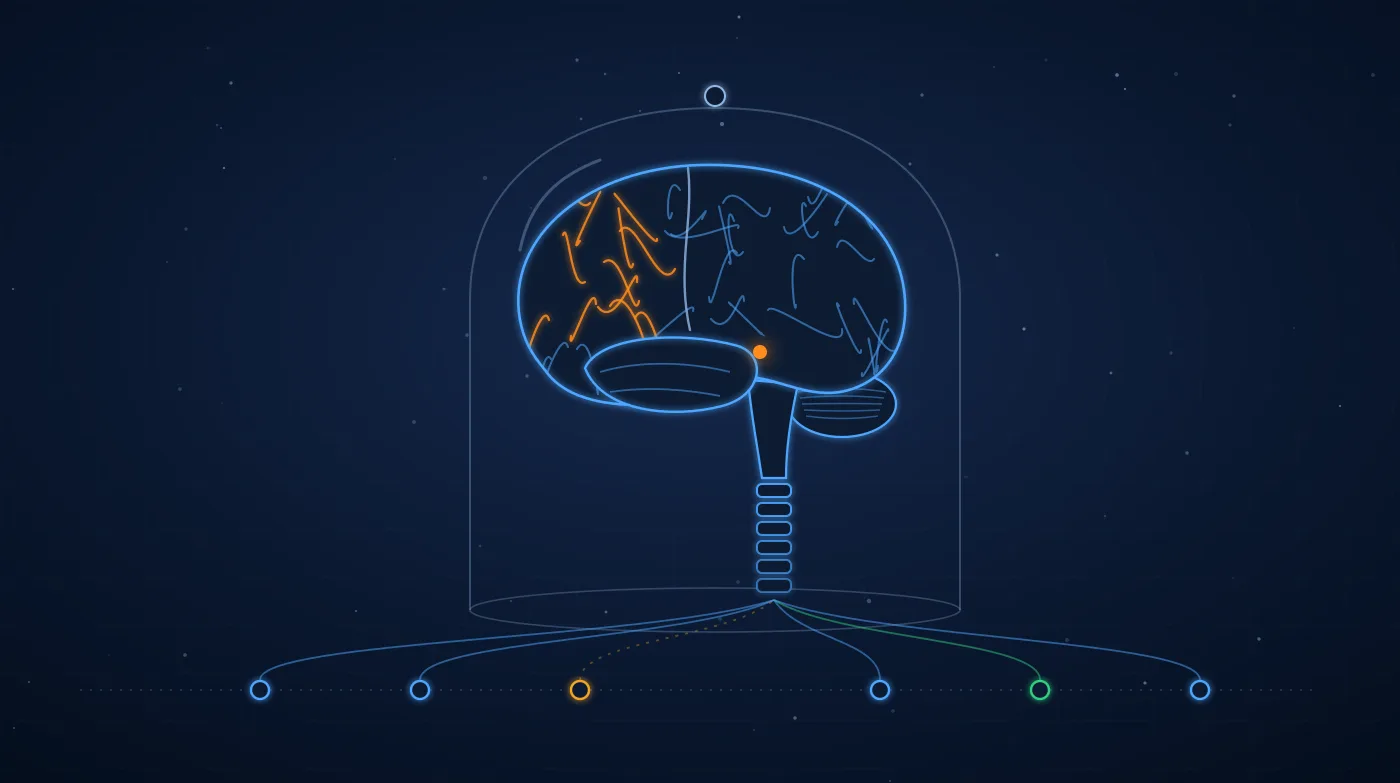
Some companies have been “doing an AI project” for two years and others have it stuck in the security committee. It is almost never because a better model is missing. It is because AI is the last link in a chain, and the links before it — the data, the learning, the control — aren’t there.
0data is QuantumSec’s platform that solves that whole chain inside your own infrastructure. To explain it we won’t draw boxes and arrows: we will open it the way a brain is opened on a lab bench, layer by layer, and at each layer you will see what it does and why it is there.
- 570+
- configured sources (gazettes, registries, markets, news…)
- 200+
- automatic flows (each at its own pace)
- 100s M
- documents in the platform (hundreds of millions, today)
- 0
- data leaving your house (it can run without internet)
Six signs the problem isn’t AI
Most companies don’t have an artificial intelligence problem: they have four chained problems — data, models, learning and control — and AI only works when they are solved together. You can recognize them by these sentences.
- Data “We find out too late”
- The data was published: in a gazette, on the regulator’s website, in a registry, in the local press. What was missing was someone looking every day, at every source, knowing what to look for.
- Data “We have the data, but we can’t use it”
- Spreadsheets, ERP, CRM, scanned PDFs and shared folders, each in its own format. Every AI project starts from scratch cleaning data.
- Control “We can’t send this to an outside model”
- Banking, health, legal, industry, public sector: the use case is clear and it dies in committee, for a legitimate reason.
- Models “Generic AI doesn’t understand our business”
- It doesn’t know what each code in your ERP means or how an alert is written in your sector. It is confidently wrong, and every query costs money.
- Learning “The dashboard is green and the data is broken”
- The most expensive failure, because it doesn’t show: a process finishes “fine” every night and hasn’t brought anything in for weeks.
- Control “Nobody knows where this figure comes from”
- A report says 1.2 million. From which source, which date, which transformation, which model touched it? Without lineage there is no trust.
The six sentences we hear most. Each one is a symptom of one of the four layers that follow.
The dissection, layer by layer
Scroll slowly. The figure stays at the top and the brain opens as you read: first the data comes in through the nerves, then one hemisphere moves aside to reveal the thalamus and the lobes, then the cerebellum slides out and, finally, the bell jar closes again. You can jump to any stage with the tabs.
Interactive figure: a laboratory brain under a bell jar, dissected in five stages. 00, the specimen: a platform with four layers (data, models, learning and governance) installed on your server. 01, data: more than 570 configured sources and more than 200 automatic flows (gazettes, company registries, markets, news, cybersecurity, open data), plus your internal data with OCR; full-text, vector search, relationship graph, relational and object storage with hundreds of millions of documents; distributed capture on your own nodes; each source measured against its own rhythm, because one was empty for 67 days while its process showed green. 02, models: a router picks the model by question and cost; local language models (or commercial ones with your keys), zero-shot classification, decision models with calibrated probability, time-series forecasting, vision and entity extraction; every name, figure and percentage in a report is checked against the source data. 03, learning: each alert is a verifiable prediction and the system recalibrates its thresholds with your history; training your own models on your data (beta); autonomy earned through results. 04, governance: installed on your server and able to run without internet; personal data detected and pseudonymized before reaching any model, with the real value in a separate encrypted vault; isolation between organizations that fails closed; granular access control; a cryptographically chained audit log that can be sealed in immutable storage; lineage and catalog; human approval of anything with consequences; and a dashboard that says “no response” instead of “0” when it couldn’t ask.
The most expensive failure is the one you don’t notice
We learned it on our own platform. A markets source went 67 days without bringing in a single document while its process finished green every three hours: more than five hundred “successful” runs in a row. Nobody noticed, because all that was being watched was whether the process finished, not whether it brought what it was supposed to.
Interactive chart of 90 days of a source: for 23 days it brings 40 to 140 documents a day with its weekly rhythm; from day 24 it brings none for 67 days, while the process’s eight daily runs (536 in total) stay green. If only the process is watched, the dashboard never alerts; if the source’s own rhythm is also watched, the alert fires six hours into the first day without data.
Since then the platform also watches its own sources, each against its own rhythm rather than a generic threshold: a weekly process doesn’t trigger every Tuesday and an hourly one doesn’t go unnoticed when it stops. Coverage is published too: what is missing, since when and why.
A dashboard never says zero when it couldn’t ask. If a check fails, the screen says “no response”, not “0 incidents”. It looks like a detail. It is the difference between a system you can trust and one that reassures you while something breaks.
What happens to personal data before it reaches a model
This is the question that decides security committees. The answer is a barrier that every message and document crosses before any AI model, local or external, reads it.
- 1 — The text comes in
A customer email, a case file, an incident or a question to the assistant. - 2 — Personal data is detected
ID numbers, bank accounts, phone numbers and other identifiers, before the text goes anywhere. - 3 — The user’s policy applies
Block, flag or pseudonymize. The organization decides, not the model. - 4 — The model sees a code
Where the ID number was, the model reads “[ID_a1b2]”. It can reason with it, but it doesn’t know the value. - 5 — The real value is kept apart
In a separate encrypted vault that only opens with its own key. - 6 — It goes into the audit chain
Every relevant step is written to a chained log: each entry depends on the previous one and altering one breaks the chain.
What reaches the model pseudonymized
- Customer [ID_a1b2] disputes the charge on the 3rd.
- Their account [IBAN_7f3c] has two returns.
- Contact at [TEL_09de].
What stays in the vault encrypted, with its own key
- [ID_a1b2] → the customer’s real ID.
- [IBAN_7f3c] → the real account.
- [TEL_09de] → the real phone number.
The model can answer just as well; what it can’t do is leak what it never saw.
And on top, what your team uses
On top of the four layers runs the part people see every day. You don’t need to know anything about what is underneath to use it.
- Mobile Alerts with context
- When something goes outside what is normal for you, with the recommendation and the original source.
- Chat Questions in plain language
- About all your data, with the source of every answer.
- Agents Analysis on their own
- When they detect a gap, they investigate and bring you conclusions, not lists.
- Sectors Ready-made applications
- Competitor and brand monitoring, cybersecurity for companies without a security team, regulatory tracking, market and geopolitical risk, situation rooms, demand forecasting.
- API For your systems
- Scoped keys and automatic notifications (webhooks) so data and alerts reach your own tools.
How it differs from a traditional platform
| Traditional platforms | 0data | |
|---|---|---|
| Where your data lives | In their cloud | On your server, even without internet |
| AI models | Rented and generic | Local, specialized with your data, yours |
| Time to first result | Months or years | Weeks |
| Does it know if it’s right? | No | It measures every prediction and recalibrates |
| Control | Configured once | Chained audit, lineage and human approval |
| External sources | You integrate them | More than 570 already running |
And compared with ChatGPT or Copilot? Those answer when you ask, with a model that isn’t yours and on data that leaves the house. 0data watches when you aren’t asking, works on your data inside your infrastructure and can use models trained by you. If hardware worries you, we explain it with numbers in which machine to choose to run AI locally.
How we start: one case, six weeks, fixed price
- Week 0 — A conversation
Tell us about the last time you found out too late about something that cost you money, or the AI project you have stuck because of privacy. That is the case. - Weeks 1-6 — We set it up in your infrastructure
With your sources and your real data, not a demo. - Week 6 — We measure it together
No brochure percentages: which alerts arrived, which were right and how much work you saved.
The platform is already built. What we do with you is your case; then come the next one and the next, on the same base.
Frequently asked questions
Do we need GPUs or a data center?
Not to start. Many cases run on a standard server. Dedicated hardware is only needed to train your own models or for large workloads, and we size it for you beforehand.
We already have a data lake or Power BI.
We build on it. 0data connects to what you already have, adds external data, AI and control, and alerts you if the data behind your dashboard has stopped arriving.
How do we comply with GDPR and our security committee?
With the data on your server, pseudonymization before any model, per-user access control and a chained audit of every action. We prepare the documentation for your committee. If you are also writing internal rules, our guide to an AI usage policy for companies will help.
Does the AI make things up?
Every figure and every name in a report is checked against the source data before you see it. No source, no claim.
Can we train a model on our own data?
Yes: the platform builds the training set from your already-labeled data and specializes an open model that stays installed on your machine. It is a beta feature; we will tell you honestly whether your case needs it or whether the rest is enough.
We don’t have a technical team.
You don’t need one. Alerts reach your phone in plain language; the technical side is ours. And since we are an offensive security company, the platform goes through the same tests we run in our AI application pentesting.
Which case would you start with? You have all the detail on the 0data page, or write to us: tell us your sector and we will first send you one of our public reports made with the platform itself, so you can see what it produces before we talk.
Related service
Topics
#0data #Data-platform #Local-AI #Data-sovereignty #LLM #Fine-tuning #Pseudonymization #Audit #Data-governance #GDPR
Keep reading
- RTX 5090, DGX Spark or Mac Studio: which machine to choose for running AI locally
- How an AI application is attacked: prompt injection and tool-using agents
- Jev and System 1 models: when AI stops writing and starts deciding
- Human biocomputing: security and organoid intelligence in the new AI era
- Transforming industries with AI, automation and cybersecurity